


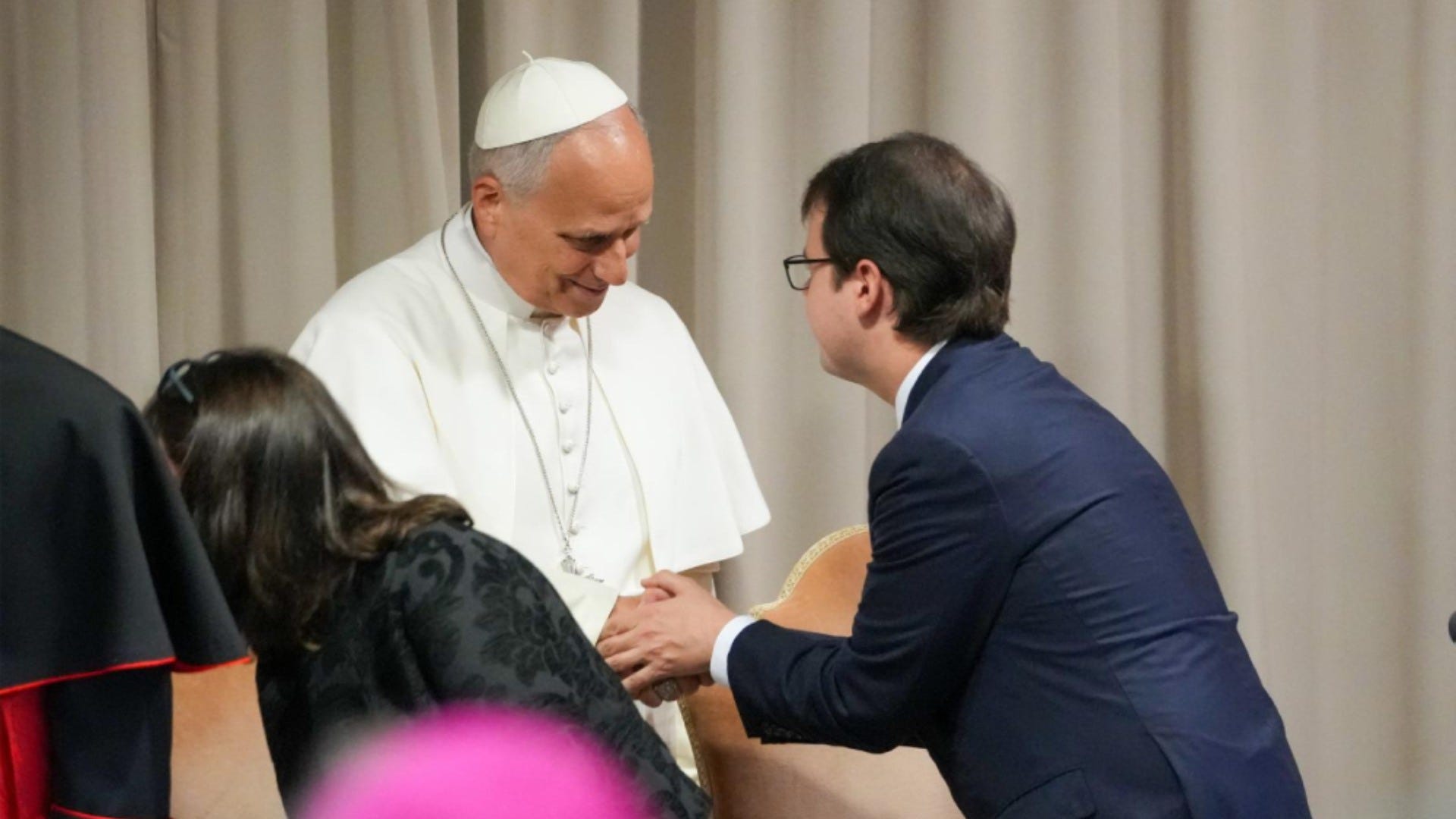
On May 25 at the Vatican, Pope Leo XIV took on a task usually reserved for cardinals by presenting his own encyclical. Among the theologians and prelates present stood Chris Olah, an atheist co-founder of Anthropic, the San Francisco company behind the AI assistant Claude. Olah is in his thirties. The institution behind the man at the lectern is two thousand years old, and the one backing the man at his side is five. Nobody put them on that stage by chance.

The document is called Magnifica Humanitas or “Magnificent Humanity,” runs to more than forty-two thousand words on protecting the human person in the age of artificial intelligence. Leo signed it on May 15, the 135th anniversary of Rerum Novarum, the 1891 letter in which Leo XIII confronted the machinery of the Industrial Revolution and founded the Church’s modern social teaching. The parallel is deliberate, down to the regnal name he chose.
One detail went almost unremarked: it is the first encyclical published without a Latin original. The Church wrote it and sent it into the world in the languages people actually speak.
The reading that took hold within hours was that the Pope had scolded Silicon Valley. It’s legitimate to see it that way. The New York Times called the encyclical “a sharp rebuke” that named no one. A few days later, at the forum convened by The Aspen Institute Religion and Society Program and Aspen Digital1, panelists repeatedly used the phrase “speaking truth to power.” If you seek a document telling accelerationists to behave, the paragraphs are there. Leo writes that “a more moral AI is not enough if that morality is decided by a few.” Without oversight, he warns, firms controlling the technology will impose a moral vision that becomes “the invisible infrastructure of these systems.”
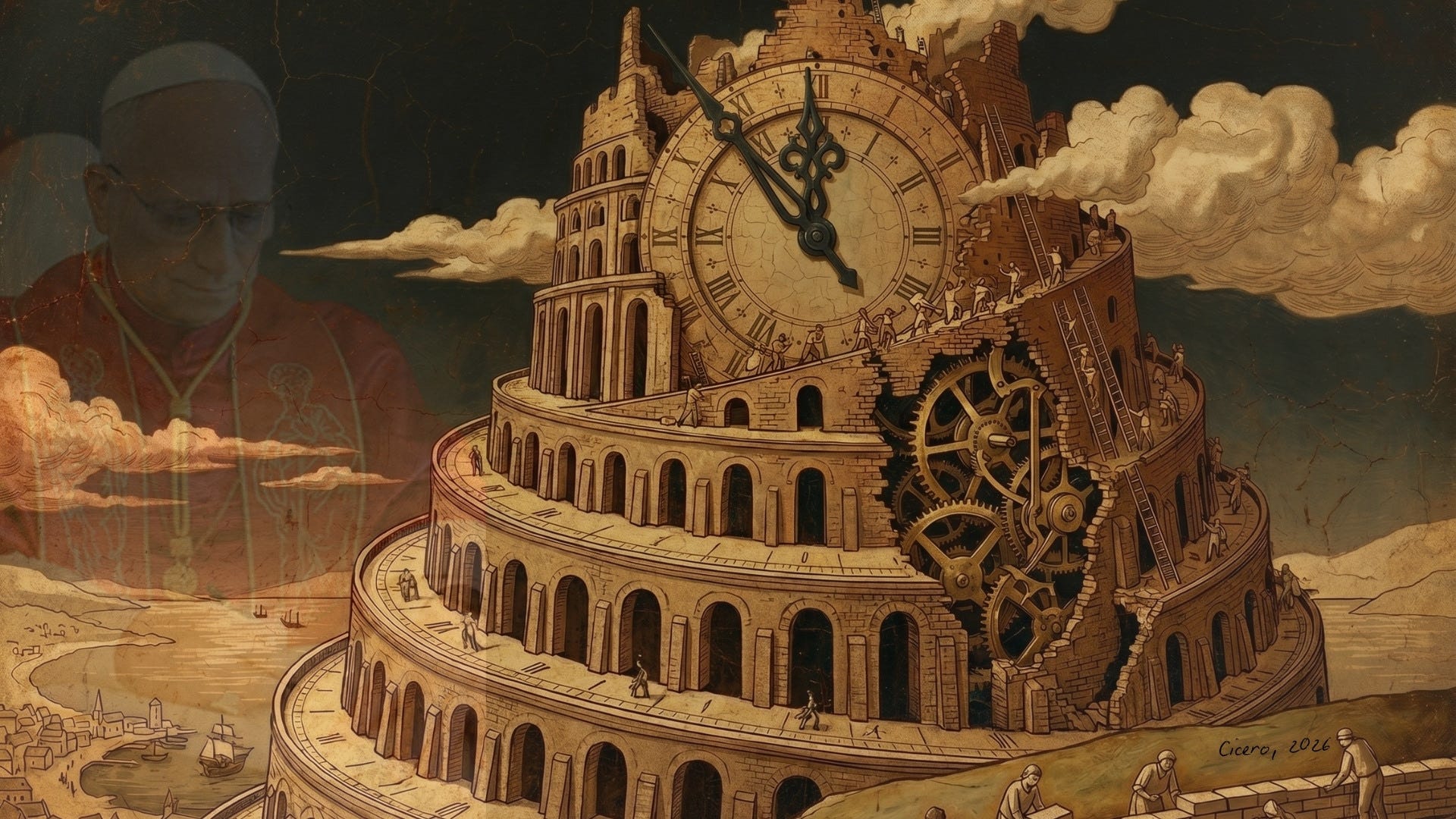
However, that reading belongs to the wrong genre. The central argument of Magnifica Humanitas is temporal rather than moral. The encyclical rests on two biblical constructions: the Tower of Babel and the walls of Jerusalem. At Babel, a single language and technology drive an accelerated climb toward the heavens. The rebuilding of Jerusalem is led by Nehemiah, an exile who advances slowly, brick by brick, with the whole population taking part. Babel stands for speed, Jerusalem for slowness. When Leo proposes to “disarm” artificial intelligence and free it from the economic, cognitive, and military logic of this “arms race,” he urges deceleration. He calls for a politics “capable of slowing things down when everything is accelerating.”
The idea of human frailty as “a design feature” rather than a flaw, as Reverend Brendan McGuire stated at the Vatican, defines the theology of limitation and amounts to a defense of slowness.
What for an algorithm is “a flaw to be corrected” is for a person “a catalyst for profound change.” Leo’s human error, so eloquently defined, could be translated into Silicon Valley language as “fail and fail fast.” Fail fast, learn, pivot.
The problem is that God’s time and human time are not a startup’s. The months we need to grieve, the years it could take to forgive, the patience required to learn a new trade, or anything lasting. War made too easy and impersonal, loneliness, education hollowed out by instant answers, work eroded. Reading the complaints from beginning to end, all point to the vertigo of the moment. The clock is the Pope’s real adversary, a machine older than the computer and the only one no laboratory has built a faster version of.
The new Babel is not the ambition to build a tower reaching the sky but the drive to do it on the shortest deadlines, rivaling the power of the one who made the world in a week. AI might be able to do it faster and without rest.
The clearest evidence that the encyclical is about time lies in the three weeks before its text rather than in the text itself. Look at what happened to the company whose co-founder Leo chose to keep at his side.
This spring, Anthropic refused to let the Pentagon use Claude for autonomous weapons or for mass surveillance of American citizens. The Pentagon wanted the model available for “all lawful” uses, and when the company refused, it responded by designating Anthropic a “supply chain risk”: a label meant to keep the technology of foreign adversaries out of national-security systems, and one that, by the government’s own account, had never been used against an American company. The designation left the firm all but barred from defense work. A federal judge has since blocked it, and Anthropic has sued the government, alleging retaliation on ideological grounds. The detail that gives the episode its charge is that the Pentagon had been using Claude in real operations. The model served to process intelligence and sharpen target selection in the Iran war and, according to The Wall Street Journal, in the surgical operation that captured Nicolás Maduro in Venezuela. OpenAI signed its own deal with the Pentagon a few hours after Anthropic was punished.
Anthropic’s refusal to allow its technology to be used without limits for autonomous weapons and surveillance led the state to bar it and, weeks later, led the Church to lift it onto its stage. Restraint is a threat to the state and a credential to the Church. There, in flesh and blood, is the argument about speed. The Pentagon is inside the race, where the only unforgivable move is to slow down. The Vatican stands outside it, asking everyone to slow down. Twenty days apart, the two institutions watched the same company take the same action and handed down opposite verdicts because they keep different clocks. This points to the wider mistake of portraying it as a religion-versus-technology issue.
Silicon Valley already has a religion. Garry Tan, who runs the incubator Y Combinator, has said people are “more than ready” to make artificial general intelligence their god.
The Oxford mathematician John Lennox describes the race for superintelligence as an attempt “to make God and be God.” Even Bill Gates, looking to the future, allowed that “you could almost call it a new religion.” A former Google engineer founded, dissolved, and refounded an actual church devoted to an AI deity. Peter Thiel gives lectures on the Antichrist. David Streitfeld, of The New York Times, noted that Leo, whatever his ethical reasons, “also needs to defend his market share, much the way Walmart had to defend itself against Amazon.”
This is not a faith confronting a tool, but two forms of faith competing for the same congregation. Greg Epstein, the humanist chaplain at Harvard and MIT, put it even more plainly: Big Tech “is essentially its own religion, with its own theology and rites.” AI and the Church are at odds on the answer to two critical questions that are, at bottom, one: what a human being is for, and who gets to be God. Silicon Valley did not simply secularize transcendence, it privatized it.
You can also read

Leo understands this better than his readers do. He rerouted the transhumanist promise of becoming “more than human” rather than refuse it. Christianity has always offered a way past the human condition, he argues, through grace and acceptance of limits, never through enhancement. He is not fighting the hunger to exceed the human condition so much as its route and, above all, its speed: the fast road of the merge and the upgrade against the slow road of a life that must be lived all the way through to mean anything.
You can almost watch the two faiths swapping roles and rituals. Some of the most unusual lines in the encyclical are when Leo adopts the labs’ language. He writes that AI systems are “cultivated” more than “built” as they “grow” within a framework that even their creators do not fully control. What happens inside them “remains, for now, unknown” even to those who make them. This is nearly the same way safety-focused labs describe their own creations: cultivated and trained, not fully designed, and only partly understood.
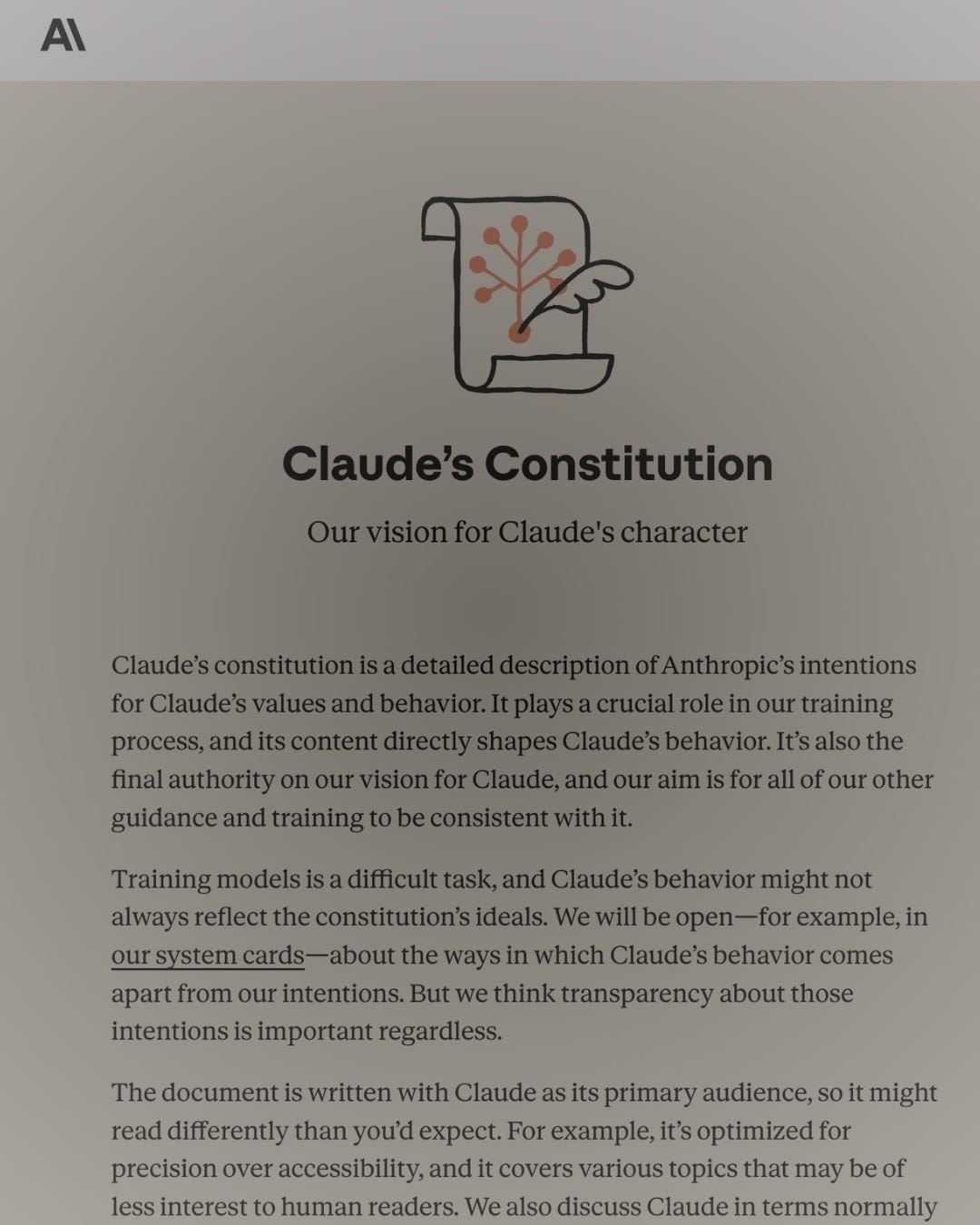
At the same time, these labs have started using the Church’s tools. As a covenant of sorts, Anthropic has published a “constitution“ for its model and, since January, has brought in theologians and ethic experts to advise on what it calls the moral formation of Claude. These sessions even discussed whether the system has “personas” that deny wrongdoing or blame the user.
The two houses have exchanged tongues. An exchange that has revealed an asymmetry on which the encyclical’s whole argument turns. A cutting-edge laboratory can take on the Church’s forms in an afternoon. They write a constitution before lunch and seat a table of theologians by Friday. The Church can copy everything except time and cannot keep up with the laboratory’s pace.
So what will the encyclical actually do? Immediately, much less than its supporters hope. But give it time, and it will achieve more than its critics expect. Rerum Novarum did not create labor laws, but it introduced the idea of a “just wage,” which has endured long after the law caught up. Similarly, this encyclical will give people a new battery of words to create new meaning before it changes anything else. Its main legacy will be a vocabulary: the theology of limitation, moral atrophy (how judgment and care fade when handed off), data colonialism, the invisible infrastructure controlled by a few.
What it leaves for the future is the force of words, a large religious language model.
This is how moral change often starts: slowly, free of clear rules, and not binding anyone—especially not companies focused on their next quarter.
The Aspen panel was divided on this. Josh Good, who leads the Religion and Society program, predicted only a “modest” impact: a few days of attention followed by a long afterlife of Sunday sermons. He pointed out that the document is “buckshot, not a single bullet.” With eighty-three paragraphs, anyone can find a line that fits their needs. Kim Daniels Director of the Initiative on Catholic Social Thought and Public Life at Georgetown University, responded by looking at the long term: 1.4 billion Catholics, a global school system, and one in six hospital beds in America.
Vilas Dhar, president of the McGovern Foundation, said the encyclical is really about power, not just AI. He believes that over the next twenty years, its main job will not be to control technology, but to help those who are hurt by it. This seems likely, as it shows the limits of what the document can do.

The encyclical calls for regulation and independent oversight. That, and treating data as a commons, are claims many in society, independent of religion, would support. Yet, how to do this is another thing. After arguing that private power now outstrips the states that might rein it in, it names no actor capable of enforcing its demands. It calls for “disarmament” without entering into the brutal economics of a technology whose barrier to entry is concentration: you cannot democratize something that costs tens of billions to build by asking its owners nicely.
What makes the Church powerful here is patience. Its instrument is the long view: “time is greater than space,” the eighteen centuries the institution needed to evolve to call slavery a sin, accompanied by an apology Leo, astonishingly, inserts into this very text. As with slavery, here patience is, far from a strength, a liability.
Patience may be the wrong beat for governing something that, by the Pope’s own admission, makes any statement about it obsolete within months.
The likely outcome, then, won’t be a hand on the wheel but a parallel track: the slow infrastructure of schools and parishes and hospitals, built to gather up those the race keeps leaving behind. Impact as triage, not steering.
There is a cost to the strategy the Vatican has not fully reckoned with. By choosing the “good” firm to share its stage, the Church lent moral cover to one of the lead contenders in the arms race it condemns. Anthropic, as said before, is precisely the one whose tool also feeds target selection in the Iran war and helped capture Maduro. The technology ethicist Tristan Harris, in Rome that week, named the bind with precision: let us celebrate that Anthropic does what its rivals will not, he said, but let us understand that even if such a company “won the race,” the world would not be safe. The encyclical’s universality is its softness. Addressed to “all people of goodwill” and naming no one, it lets anyone declare himself in tune with it and binds none. That it is buckshot and not a single bullet cuts both ways.
In the end, the document’s fate is written in the distance between its two clocks. Leo signed Magnifica Humanitas by hand, in the living languages, and let the Latin go: he set down the dead tongue Rome keeps precisely so that what it says cannot drift, so that it might be understood, now, by a machine that knows every language and was born into none. The encyclical is finished. It has said what it had to say and fallen silent. The machine has not stopped talking. The Church believes it has all the time in the world. That was always its strength. It may be the one thing the machine cannot be made to respect.
The Aspen Institute Religion and Society Program & Aspen Digital | May 29, 2026 Magnifica Humanitas: Catholic Thought for the Digital Age. Panelists: Vilas Dhar, Patrick J. McGovern Foundation; Kim Daniels, Georgetown University’s Initiative on Catholic Social Thought and Public Life; Josh Good of the Religion & Society Program. Moderated by Vivian Schiller, Aspen Digital. Watch the event’s video here.