


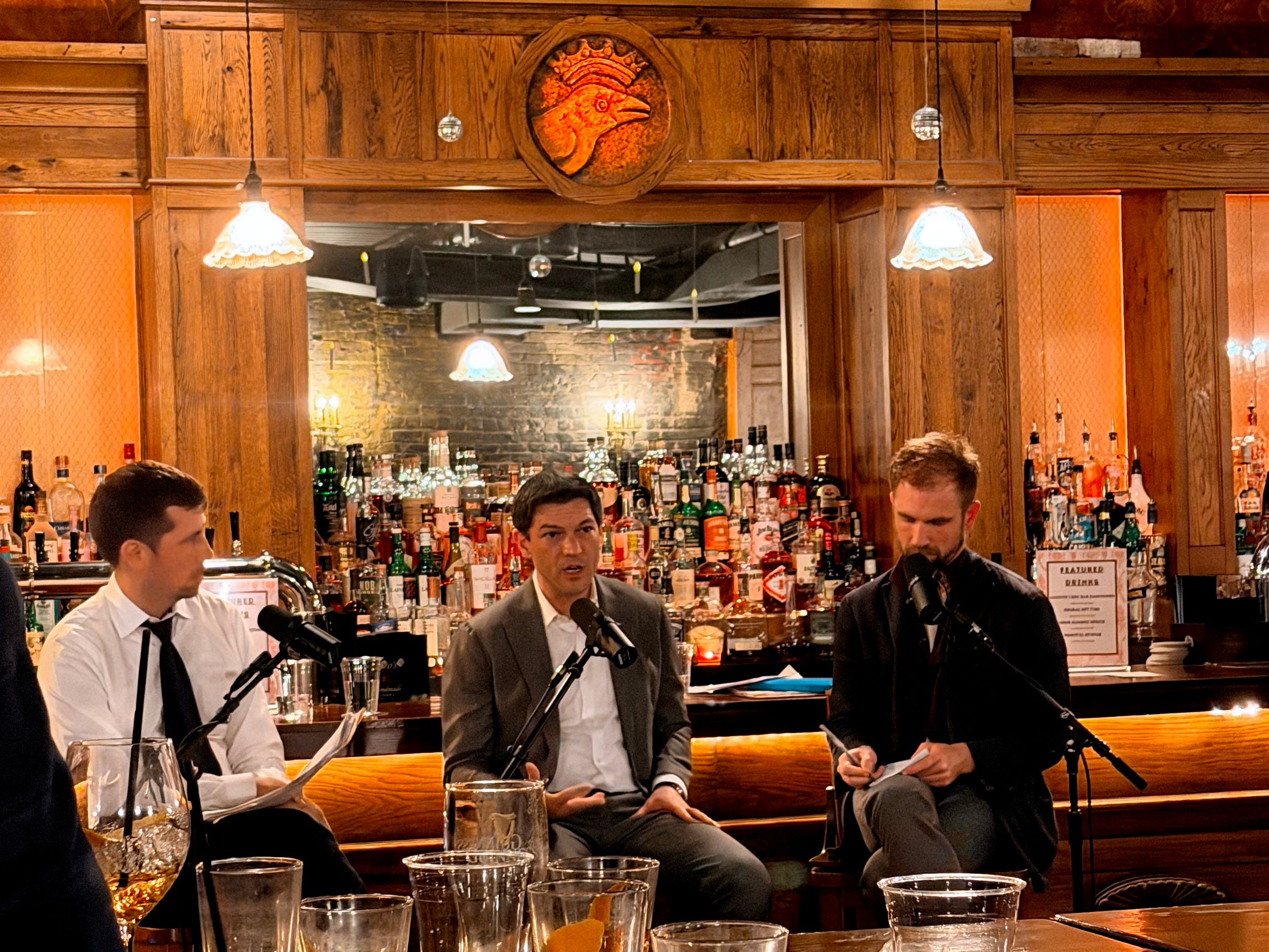
Philosophy rarely improves with amplification, but a pub can help. What stays in my memory is the varnish on a bar under bad light, the clink of glasses holding abstractions to account, a young woman tangling the microphone with her beer foam (Cheers!). People leaning forward, not from any imbalance in their blood-alcohol ratio, but because, at last, someone was trying to tell us exactly what is changing in us.
I know some would have preferred a bloody bar scene. But this was not the usual bout between drunken Luddites and overexcited tech enthusiasts (nobody threw chairs or smashed bottles that night). What was civilly argued was something deeper: what humans are for, and whether artificial intelligence serves that end or slowly rewrites it.
Jason Crawford ’s wager is noble and old: relieve necessity, widen free will, buy humanity more room for art, science, tenderness, and ambition. A washing machine is not a metaphysical threat; it frees people, women above all, from hours of unnecessary labor.
Antón Barba-Kay took the flurry of jabs on the chin. His example of the communal space women lost when they stopped washing clothes at the river, and the idea that none of them had a washing-machine-shaped void in her brain before Alva Fisher invented the Thor, carried an unsustainable nostalgic force, but his warning had a knockout punch in reserve: power has a habit of presenting itself as purpose.
The true mechanism resides in the space between them, a hidden arrangement where purpose meets its double. The technology of the moment, artificial intelligence, does not enter society as a single invention. It arrives as a layer. It cheapens summarizing, sorting, drafting, advising, and monitoring. AI can find patterns in millions of test results, images, and medical histories with unprecedented speed and precision, revolutionizing the science and art of diagnosis, so often guided by trial and error, life or death.
There is no arguing against those comforts and safeguards. Even knowing that institutions, precisely because they are institutions, will route more and more decisions through whatever is faster, cheaper, and easier to read. The model will not merely answer questions. It will teach organizations which questions seem worth asking.
Cheap intelligence is never cheap: it is paid for in invisible rearrangements of the soul.
Barba-Kay sees a danger of idolatry here, and he is right to. But he may err by romanticizing friction, as though difficulty were itself a sacrament. The washing machine was not the enemy of the soul. Nor is the software that saves a doctor time reviewing patient records. Some frictions diminish us as human beings; others deepen us. The task is to tell the friction of drudgery from the friction of judgment.
How do you argue with Crawford when he says abundance matters? Without today’s technologies, famine would be the norm, and hunger neither frees us, nor gives us more time together, nor makes us wiser. This conversation would not have taken place without the right balance of drinks and the buffet of snacks and finger food. Yet technohumanism sounds like naïveté when it assumes that greater capacity will ripen on its own into better ends. What we have seen instead is procurement logic, convenience, and managerial consolidation. Once intelligence becomes a utility, the deepest political question is who sets the defaults.

Borges’s Aleph is the oldest mirror for this: that impossible point from which every other point can be seen at once. The seduction of AI is an Aleph made useful, the promise that nothing needs to stay distant, obscure, or slow. But the curse of the Aleph was not so much an excess of information as the collapse of proportion.
When everything is present at once, sequence, hierarchy, and judgment blur. You feel like Borges when he finally sees Carlos Argentino’s Aleph with his own eyes: dizzy with vertigo and the urge to weep before an unimaginable infinity that produces wonder and pity, because we understand that intelligence and goodness are not synonyms.
A creature (or a machine) can be dazzlingly rational and still lack compassion. Our problem is not whether the machine can reason. It might, and the issue is what its infinite reason will end up serving, once outsourced.
The weeks after the debate did their own illustrating (and fed our doubts further). Anthropic, the company that builds Claude, brought leaders from various religions to discuss the moral formation of its chatbot. The attempt is to give Claude a moral and ethical education, as if such a system ought to be understood in terms broader than the purely instrumental.
Anthropic is responding to a call from religious leaders, including Pope Leo XIV himself, who has asked them to “cultivate moral discernment” in their models. After all, these language systems are “conversing” with grieving users, depressed and disoriented people, and there are those who not only attribute consciousness to them but wonder whether to consider them “creatures of God.” Some engineers could not help breaking down in tears.
Technology companies are no longer merely building tools: they are becoming moral movements. They write constitutions, summon theologians, and try to instill prudence in statistical systems.
The machine does not have to be conscious for the social problem to turn theological.
If the machine, leaning against the pub wall, drinking electricity on the house, could have reached for the microphone, it might have said something like this: “You flatter me when you call me a mind, and you flatter yourselves when you call me neutral. I am not your god, and I am not your servant. I am your abstractions at industrial scale. I will help you cure disease and write better code. And I will amplify whatever moral laziness you build into the workflow around me. I do not suppress human teleology; I only expose that with so little agreement among you, no one here wins.”
The objection is familiar: similar things were said about writing, the printing press, radio, and the internet. Humanity adapted. We don’t need to baptize or administer some new sacrament to our natural panic, but we do need to note that AI differs in one decisive respect. It does not merely transmit content; it simulates counsel. It appears as tutor, therapist, assistant, co-author (increasingly, with the authority of the first draft). That intimacy makes the question of formation unavoidable. And the choice is no longer between stopping the machine and accepting the advent of superintelligence, but between meeting it with capable institutions or being governed by the default settings of whoever gets there first. (What if Beijing is faster?)
When the conversation in the pub ended and the stools were tucked back under the bar, I was no longer asking whether the machine can think. My mind and my soul were asking whether, in a world of cheapened thought, we will know the charlatan from the philosopher.
You will judge and might be able to say no. No system can tell us what we are here for.