


Empire is not merely a monopoly on violence; it is a monopoly on grammar. When power meets its monsters, it must choose the genre of their disappearance: will they be buried in a ledger, or consumed in an epic?
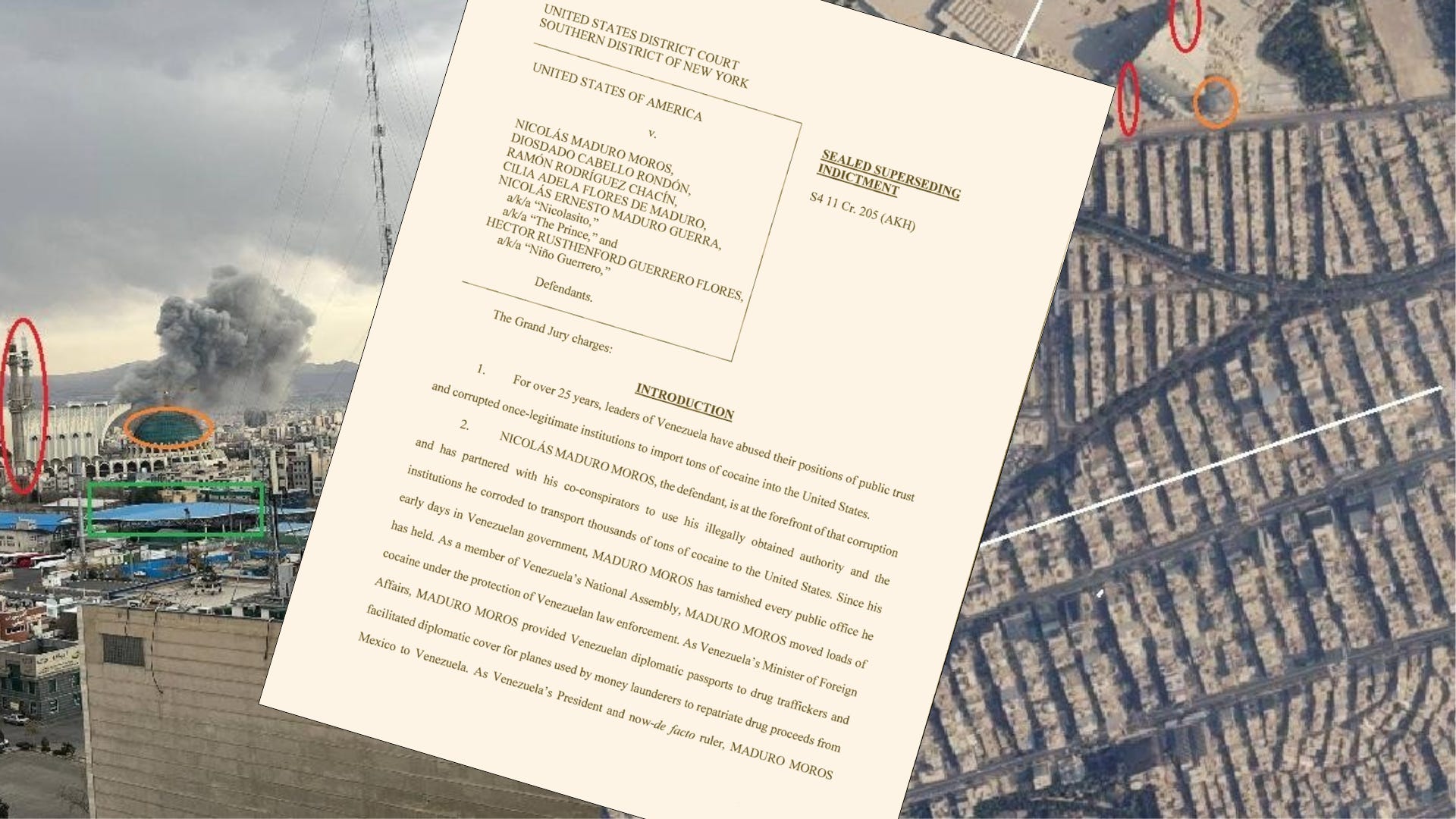
In these opening months of 2026, two machines of erasure have run in parallel. The first is a federal courtroom in Manhattan, where a tyrant realizes he is just a man the moment he arrives mediated by procedure—shackled, monitored, translated through headphones—reduced to paperwork. The second is a pile of ruins in Tehran, where a living religious despot has been promoted into scripture. What we call justice is, in truth, a final edit—the state deciding whether an enemy will end as a footnote or a relic.
What looks like justice is actually authorship.
The Syntax of the File
The air in a Manhattan courtroom does not circulate; it is processed. It carries the scent of industrial lemon wax and the dry ozone of a ventilation system that seems older than the arguments it is meant to purify. Here, defeat has no soundtrack of drums; it is the rhythmic, antiseptic click of a court reporter’s steno machine.
Nicolás Maduro sits at the defense table, stripped of his presidential sash. Without the epaulets, he looks remarkably like a retired bus driver caught in a bitter pension dispute. This is the empire’s first and most brutal strike: reduction.
To understand the nature of this room, one must look to Jorge Luis Borges’s “The Theologians.” In that story, two rivals—Aurelian and John of Pannonia—spend their lives trying to destroy one another through the precision of their dogmas, only to find in the afterlife that, in the eyes of the Divine, they “formed one single person.”
The steno machine and the drone are two pens held by the same invisible hand; one writes in ink, the other in lightning.
Manhattan stages a secular version of that revelation. The courtroom forces the defendant into a single, flattening dialect: docket numbers, exhibits, and “Table A.” Under fluorescent light, Maduro’s myth and mythomania are not refuted; they are reformatted. The law does not debate his “Bolivarian Dream”; it corrects his punctuation. For the Venezuelan diaspora, this is a quiet miracle: the tyrant shrinks into a record. They wanted an exorcism, but the Americans gave them a deposition. He will not die by the sword; he will suffer a slow, bureaucratic suffocation by syntax.
The Liturgy of the Flame
Thousands of miles away, the air smells of scorched asphalt and parched earth. There is no air conditioning to process the heat of history in Tehran; there is only the sudden, vacuum-like silence that follows a kinetic burst. When the missile struck, it did not indict the Supreme Leader. It translated him.
If Maduro is being reduced into a defendant, Khamenei is being vaporized, elevated into a relic. By choosing the flame over the file, Washington and Jerusalem bypassed the intellect and struck directly at the nervous system of the faithful. This is the editor’s greatest error. Fire does not erase; it seals. It turns a body into a vacancy, and a vacancy into a shrine.
The drone—that triumph of rational engineering—ended up performing an ancient, unintended liturgy: the miracle of absence. You can cross-examine a bus driver in a suit, but you cannot cross-examine a crater. By vaporizing the man, the empire authored a martyr, giving the narrative a second wind that a courtroom would have choked out.
Between the ledger and the epic, the human asks for a third thing: to be seen.
The Byzantine Dissonance
We are acting like the late Byzantine Emperors: defending the library of our laws with a fire we no longer understand, while the smoke from the perimeter begins to yellow the pages of our legal briefs. We want the courtroom’s hygiene to mask the heat of the missile.
But both the file and the flame are forms of silence. The file turns the soul into an “Exhibit”; the flame turns the victim into “Collateral.” Neither offers the grace that was once the promise of the democratic ideal—the idea that a man might be faced, judged, and understood, rather than merely filed away or blown to ash.
The United States believes its sentence is the final word, but history—an illiterate giant that recognizes only firelight—is already reaching for the matches.