


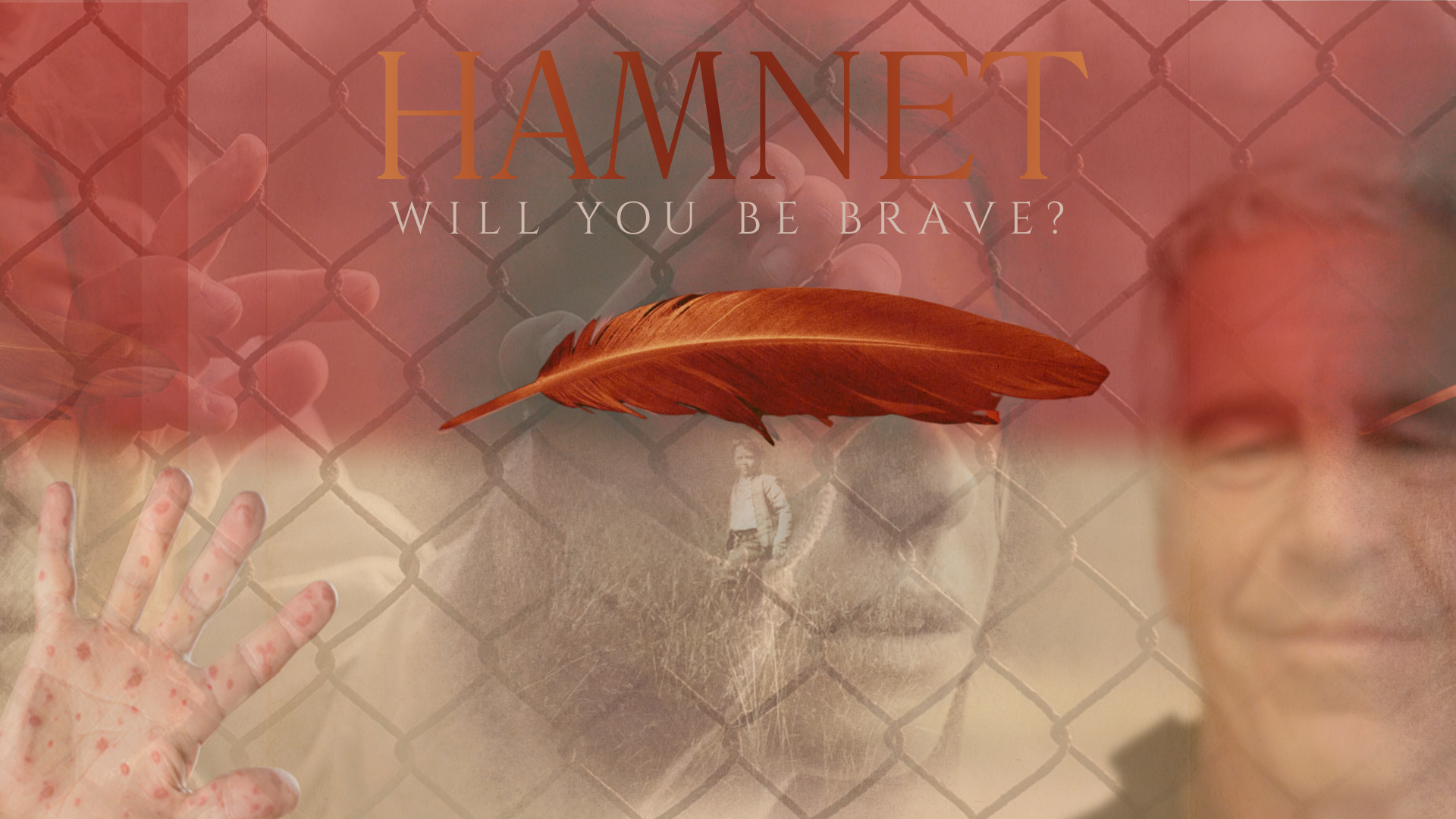
In Stratford’s damp, herbal dusk, a mother wages the oldest war: bargaining with the void.
In Maggie O’Farrell’s Hamnet, now translated into the flickering, lyrical light of Chloé Zhao’s cinema, Agnes Shakespeare moves through her garden, grinding rue and feverfew between calloused fingers. She tries to coax a miracle into a cup for her eleven-year-old son. But the plague has already arrived, hitching a ride on the back of a flea (an invisible executioner with no ear for poetry). Her husband, William, is miles away in London, seduced by the alchemy of the stage, busy becoming immortal while his lineage thins toward the spectral.
With Hamnet now headed to the Oscars—nominated for Best Picture and Best Director, among others—we should ask why this story punctures us so cleanly right now. It isn’t mere historical nostalgia. It is recognition. We watch Agnes and glimpse our own terrified reflection in the windowpane. We, too, live among invisible executioners, and raise children in the long, cold shadow of absences we refuse to name.
Neglect is the only virus that requires our permission to spread.
The Geography of Neglect
The plague has returned, but it has traded its buboes for new disguises. It is the old contagion that flourishes when memory becomes porous: measles flaring in places where vaccines have been traded for theology, grievance, or vibes. Children do what children do, playing in the playground, touching, breathing, before the quiet return of preventable fevers to communities that now treat public health as a private preference rather than a civic pact. In 2025 alone, the CDC recorded 2,280 confirmed measles cases and 49 outbreaks, with the vast majority linked to outbreaks.
But the sickness is not only biological. It is a failure of stewardship. We have become a society of figurative Londoners while we are transfixed by scandal’s stagecraft, by the digital bonfire of “the list.” Algorithm-fed outrage keeps us warm for a night and leaves us hollow by dawn. We are in the city, chasing the theater of our personas, while our children remain in Stratford—in the realm of the real—close enough to touch, yet far enough to neglect.

We are ghosting the living
We see it at the borders, where childhood is processed into paperwork, and a small hand is separated from a parent’s grip by the cold typography of a policy memo. We see it in the Epstein-era real estate market of predation: private islands and locked doors where the vulnerable could aspire to become furniture, but most likely end as consumables. And we see it, most brutally, in the American newsfeed: a youth hockey game in Rhode Island detonates into gunfire; a teenager is shot in a hallway; parents drop off a child for an ordinary afternoon and are handed back a lockdown text.
The right to a weapon keeps overruling the rite of growing up. Agnes was helpless in her garden; she lacked the science. We are not. We have data, laws, and tools. What we lack is officium (Cicero’s word for duty, for what is owed) to pick them up.
The Borgesian Return
In the labyrinthine world of Jorge Luis Borges, a garden is never just a plot of dirt. It is a map of forked paths, a record of every moment we turned left instead of right and called it fate. Our unattended garden is exactly that: it isn’t ruined by one singular catastrophe, but by the daily, microscopic decision not to water, not to weed, not to show up.
The redemption in Hamnet is not that the boy miraculously survives. He doesn’t. The redemption is that the father finally returns. Shakespeare is riddled with guilt. He flees the domestic real for the stage’s bright machinery, as if applause could drown out the silence of a child’s room.
A garden does not die by a single lightning strike, but by the daily, quiet withdrawal of the watering can. We call it fate to avoid calling it a choice.
But eventually, he stops pretending the play is more important than the boy. He takes that suffocating grief and builds a room for it. He writes Hamlet. He gives the dead boy a voice that echoes through centuries, turning a fleeting absence into a presence so relentless it forces the world to look straight at the ghost.
The Rule of the Garden
For us, the path is brutally ordinary. We must leave our London of profitable distractions and return to Stratford, where the stakes are not symbolic.
This return must be our officium. Presence is not a sentiment, but a schedule. It is budgets, staffing, vaccination clinics, and laws that treat a child’s safety as the first principle of a civilization, not a negotiable cost in a political auction.
We cannot write a play to bring the dead back to life. We cannot undo the invisible executioners of the past. But we can write the rules of the garden. We can choose a social contract that says, without euphemism: we will not ghost you again.
You are not a ghost. You are the garden we are sworn to tend.