


Léelo en español
The National Gallery of Art in Washington, D.C., has a particular hush, like a library that has finally forgiven you. Recently, I stood there with colleagues, practicing what Mary-Hall Surface calls “seeing together.” We were not there to know art, but to meet it: to treat attention as civic intimacy rather than a private hobby.
Mary Hall, a museum educator and playwright, offered a prompt meant to slip past the mind’s sentries: “I feel… [what] in/through/because of… [what]…” Name the weather inside the chest, not the trivia on the wall.
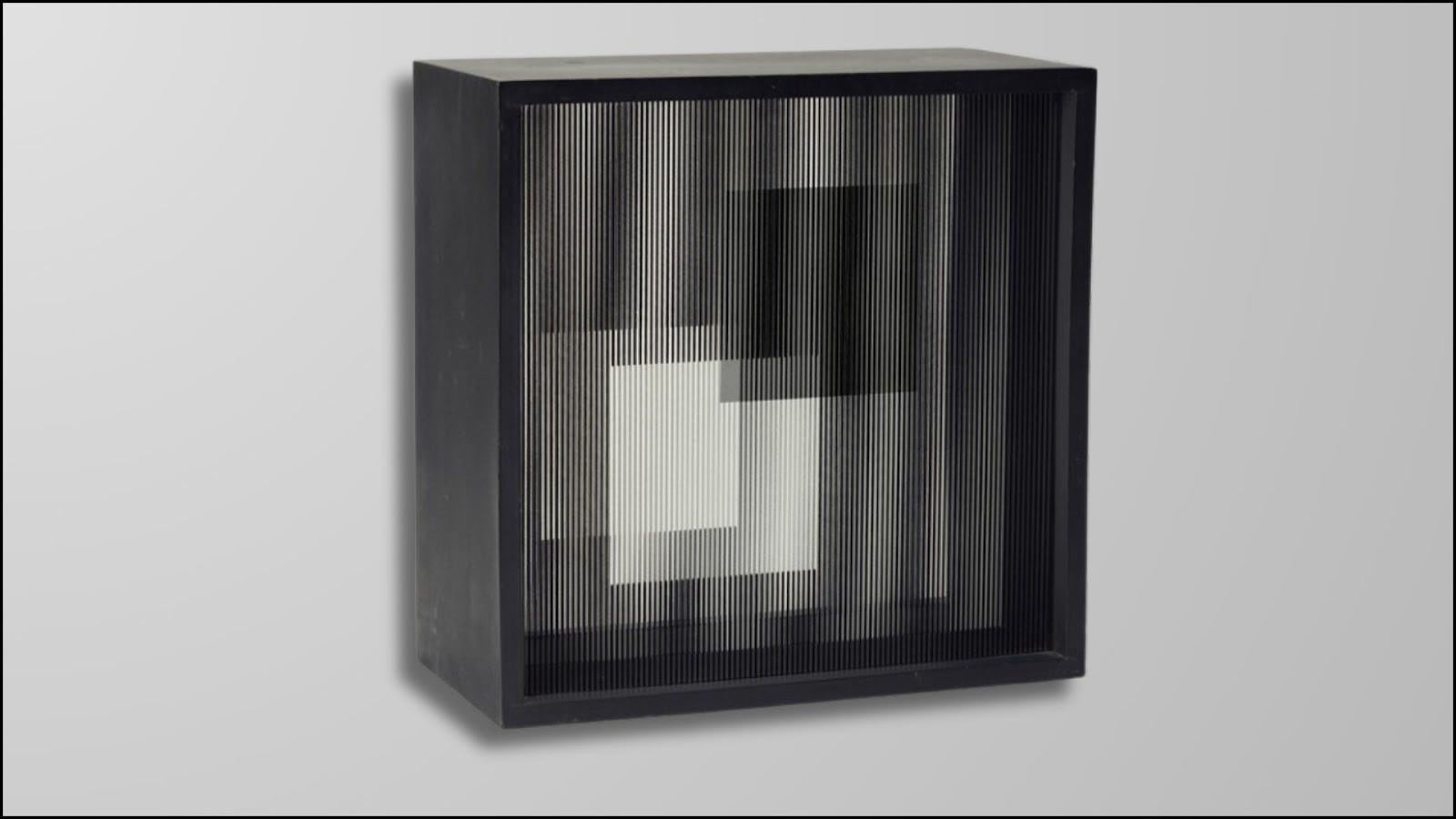
Then I saw it: Jesús Soto’s Optical Box (1964). Hidden in plain sight among the American and European masters, a modest black square, a Venezuelan artifact sitting calmly in Washington as if it had always lived here. Plexiglas, parallel lines that will not hold still. Lean a fraction left and the interior reorganizes. Lean back and it rearranges again. The movement is not in the object. It is in the relationship.
I felt a jolt of recognition. I grew up with Soto, a god of art and physics to me. The first time I encountered not one but two, three, was in the Museo de Arte Contemporáneo de Caracas. I was 9 years old, and his language of vibration was my early education in what abstraction can do: not decorate reality, but unseat it.
Since the horizon of my country hardened into something I could no longer cross, the appearance of this box made Venezuela feel portable. Not a flag, not a slogan, but light insisting on a stubborn truth: home is not always a place. Sometimes it is a way the eye refuses to surrender.
And yet, in that same week, on the other side of Constitution Avenue, Venezuela entered the U.S. Capitol in the opposite mode: not as a tremble of perception, but as a trophy. In the State of the Union, the rhetoric was blunt: the end of a “reign,” the promise of a “bright new beginning,” the flourish of a “colossal victory.”
What looks like a political triumph is often a struggle over who gets to frame reality.
A frame is never innocent. It decides what counts as foreground and what is allowed to vanish into the margins. Cicero sees here a triumph: the conquered marched through the streets so the empire could feel its own solidity. The spectacle was less about the defeated than about the audience’s need to believe the world was, at last, understandable.
Borges drew a map so precisely that it replaced the territory. The danger is not error, but totalization. When a political story becomes a closed loop, it stops describing life and starts suffocating it.


This is why Soto matters. His Optical Box is a small machine for humiliating certainty. It refuses the sovereign viewpoint. Its lesson is physical: if you want to see, you must move. If you want to understand, you must accept that truth shifts with position.
Triumphalism cannot tolerate this. It wants Venezuela to sit still, folded into a domestic ledger (oil partnerships, geopolitical receipts) turned into evidence of competence.
Sovereignty is a frame that begs to be believed.
A trophy is a coffin with good lighting.
Exile is the theft of your right to name what happened.
Mary Hall, your exercise reminded me that the first person is not narcissism; it is responsibility. “I feel” is a refusal to outsource perception to the loudest narrator. The clean story costs less to carry. That is why it travels.
Authoritarian stories love grandeur and hate subtlety. Nuance requires a second look, the humility of admitting your angle is not the only angle. A box like Soto’s is dangerous to the politics of trophies because it trains us to doubt our first certainty.
At the end of our session, Mary Hall asked for a poem about what we saw. I wrote:
“Stranded in a foreign hall, I found my house inside a box. Is it an optical trap or a map of the universe’s shifting floor? I bow to the vibration of light, to the uncle, the friend, the shore no longer here, yet unwilling to stay still.I found a nation in a square of glass: a geometry of what remains. Not a map, but a haunting a trap where light and grief refuse to be a trophy.Here the light does not settle, and the dead do not depart: they only wait for the eye to move.”
Grief is its own kind of perception. It keeps scanning the world for what is missing. In the Capitol, Venezuela is framed as resolution. In the museum, it remains an unresolved vibration. The point is not to reject political change, but to reject the temptation to call any country settled simply because it plays well in a speech.
Rather than a trophy to be displayed, reality is a relationship to be tended. The light does not settle. The dead do not depart.