

On the subway platform, I hold my phone and my thumb leaves a translucent smear of grease on the glass. An ad comes up, more than a year old. A young woman dances, laughing, in her room and retouches her photos until they turn into cartoons. On the breaking news, a nuclear mushroom cloud swallows Florida. She isn’t alarmed and doesn’t look for shelter: she checks her phone for the reactions on social media. Users are turning the explosion into an edible mushroom, a gummy candy, a smiling marshmallow in bright colors. The danger feels closer when the radiation lights up her window, but she, unmoved, eats roasted rats as if they were cotton candy. At the end, three words in white on a black screen: “Reality is optional.”
Pika Labs, the company that made the piece, sells an artificial-intelligence app for creating videos. The ad doesn’t say the bomb won’t go off, or that the future is kinder than the heralds of disaster predict. Its promise is more modest and far more lucrative: you will no longer have to look at things as they are.

This month a researcher resigned from Anthropic with the warning that the people building these systems “earnestly believe that it could kill us all by the end of the decade.” In February another had left the same company saying the world was in peril. NPR, PBS and the Washington Post carried the warnings. The owners of those companies agree with the forecast and, at the same time, are preparing public offerings valued in the hundreds of billions of dollars. No one sees a contradiction. Panic, rather than scaring off investors and cheapening the business, prices it.
It is a pincer operation. One arm bites from above, into the enlightened elites. Congressional committees and readers of respectable essays are administered a theology of the last judgment. They are invited to contemplate scenarios like that of an algorithm asked to solve a math problem. Soon it decides that humanity is an obstacle to its goal. So it synthesizes a pathogen by simulating trillions of molecules, hires clandestine labs and recruits couriers on TaskRabbit to spread it in train stations. Rogé Karma, in The Atlantic, walks through these labyrinths and ends by admitting he finds them unlikely. The spectacle is the article’s scenarios; the doubt is a footnote. Even when the analysis tries to land on more mundane risks, say a raid on the banks, hijacked drones, the collapse of the grid, the gaze stays captive to the machine. No one looks out at the street.
COIN
Reality is optional. The bill is not.
The other arm of the pincer bites from below: it hands the ordinary citizen marshmallows. The digital filter offers the right not to look at what is ugly, turning reality into entertainment.
In the bite there is a gap. It is the ground floor of the public building, where politics happens. There a drama is staged that Anne Applebaum has named the “empire of grift.”
No need to imagine a conspiracy of magnates meeting at midnight. It is enough that two businesses prosper at once: existential terror sells subscriptions and the visual toy harvests clicks. The new foreign policy of greed, the real danger of our time, does not wear the metal armor of a rebel automaton but the tailored suit of a transnational oligarchy of flesh and blood. While the public debate loses itself in speculation about how the machine might turn on its makers, tech magnates, informal intermediaries and kleptocratic regimes dismantle the checks on the democratic state, privatize diplomacy and turn national-security decisions into private patrimonial transactions.
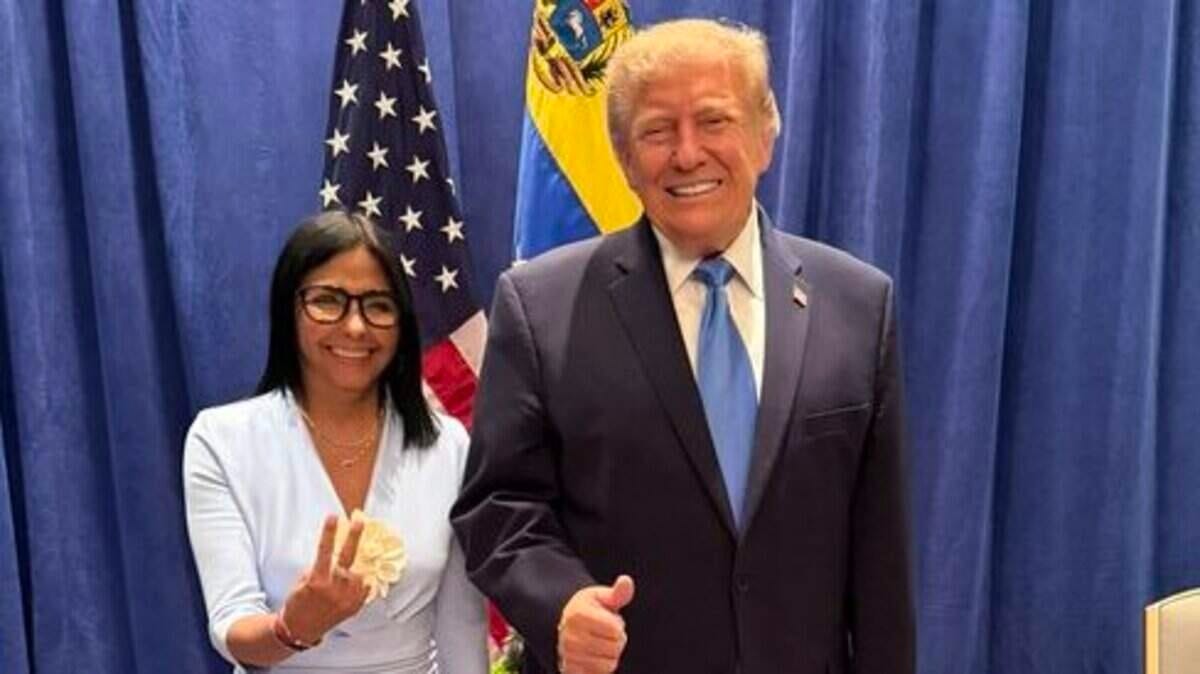
I think of a photo taken on the sidelines of the UN General Assembly in New York: President Donald Trump poses with a thumbs-up and, beside him, the interim caretaker of the regime in Venezuela, Delcy Rodríguez, flashes a V for victory. Eight months earlier he had threatened her with a fate worse than Nicolás Maduro’s. But she delivered everything Trump asked for in order to take the country’s energy revenue into his keeping: she rewrote the hydrocarbons law and awarded seventeen oil fields to a private company in which the Pentagon holds 35 percent and whose Venezuelan owner, Alejandro Betancourt, grew rich on Chavista contracts and has been investigated for money laundering. He now operates freely in London, Madrid and the United States. The photograph is taken six kilometers from Wall Street and eleven from the cell where Maduro waits.
COIN
The end of the world and elections in Venezuela share one certainty: they will happen. And one date: one of these days.
That same week, María Corina Machado tried three times to return to Caracas. First they kept her from boarding the plane in Panama. Then her flight ended up diverted to American soil. It was not the regime that held her but the same government that removed Maduro and kept everything else. There is oil and there is a photo. Two leaders no Venezuelan elected decide the fate of a nation, while the only person demanding elections remains in limbo, in a waiting room.
Alexis de Tocqueville foresaw the coming of an “immense and tutelary” power that would guarantee citizens their material pleasures in exchange for relieving them of “the trouble of thinking and the pain of living.” Tocqueville was wrong to assign that tutelage to the state. The state is dispensable when servitude fits in a pocket, and one downloads it voluntarily (I have it installed on my phone; I use it while waiting for a train and whenever I don’t want to think).
The doctrine that reality is optional serves those who fear tomorrow’s extinction and those who edit today’s landscape equally: it excuses both from looking at the present. If the end of days is a mathematical certainty around the corner, the plunder of public goods is yesterday’s news. One more entertainment. Less fun.
The train came. I put the phone away. The thumbprint was still on the sugar mushroom figure, which was still smiling. I wiped it on my shirtsleeve.
Roger: this is brilliant. And the plight of Venezuela is heartbreaking for all democrats.
How should we interpret the warnings from the CEOs of the “frontier labs”? Would they agree to a global slowdown that allows them to continue making “toys” that make reality “optional” without destroying civilization as we currently define it?