


(Leer en español)
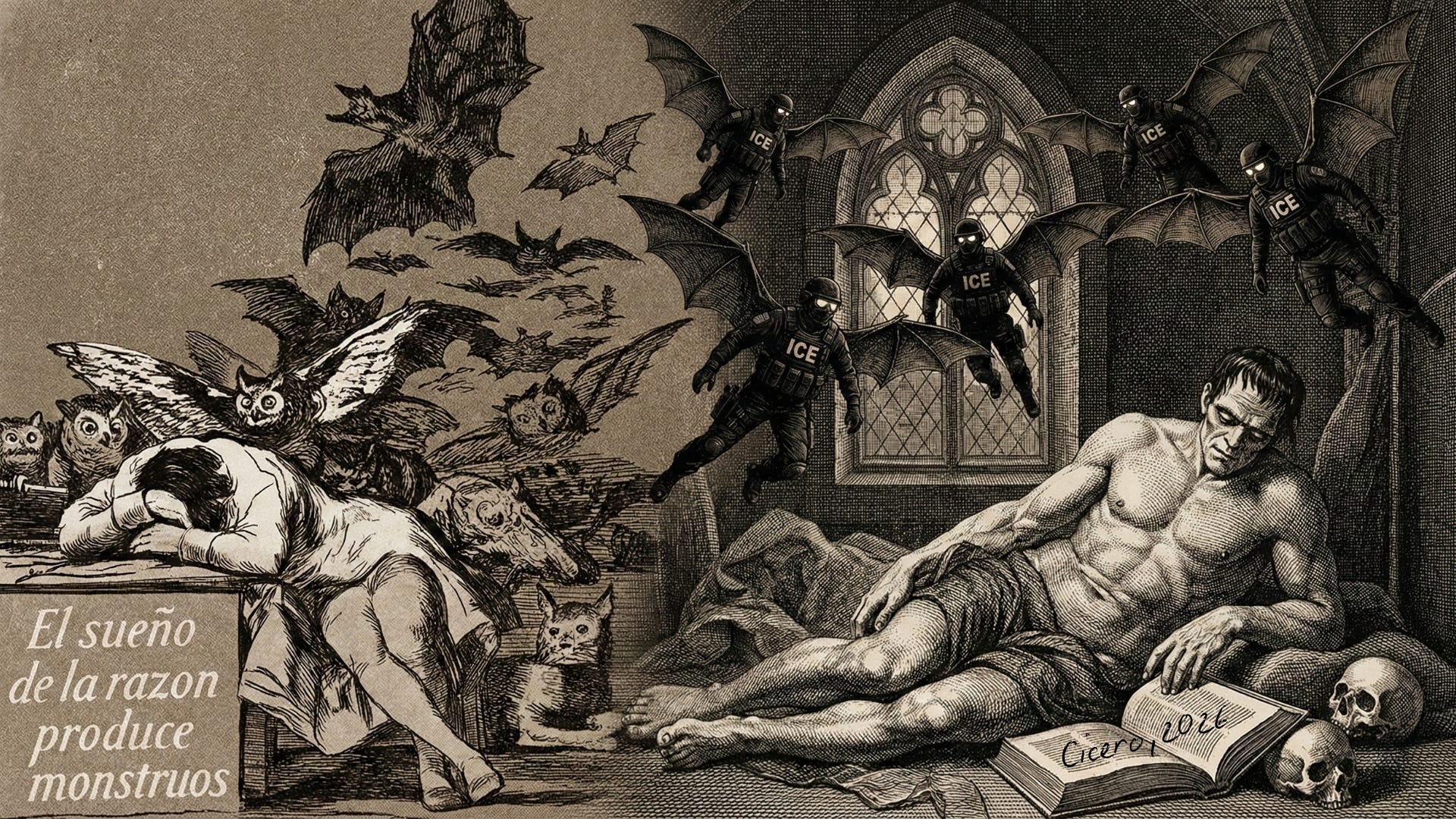
January smells of cold gunpowder and stillborn resolutions. It is a month of deceptive whiteness, possessed of that milky morning light that falsely promises a tabula rasa. Amidst the champagne hangovers and pristine planners, we tend to forget that January is also the month of monsters and prophets. On January 1st, 1818, Mary Shelley released Frankenstein, her creature, from the printing press; on January 15th, a century later, Martin Luther King Jr. was born to save America’s soul from itself.
Yet, this January of 2026 brings us neither Gothic redemption nor the unfinished dream of civil rights. It brings us—wrapped in the technical cellophane of national security—the most sophisticated deployment of human control apparatus ever designed. It is no coincidence. There is a dark irony in celebrating King while allowing ICE to become the most hypertrophied police agency in American history, armed not with torches and pitchforks, but with the glacial precision of Palantir’s algorithms (watch Wired video).
Here emerges one of the great illusions of contemporary power: the belief that technology makes us more rational, when in reality it often only makes our cruelty more efficient. The problem is not that the State has become an irrational monster; the true terror lies in the fact that it acts convinced of its perfect, aseptic, and mathematical rationality.
Shelley’s creature—that assemblage of disparate limbs stitched together in haste—was not born a monster. He became one under the gaze of the other. Upon learning to read, he turns to Paradise Lost. There, he reasons, feels and plants a question that continues to disarm moral alibis two centuries later: “Was I, then, a monster, a blot upon the earth, from which all men fled and whom all men disowned?” To demand that he be treated as a demon merely for his appearance, for being what he is, is not an aesthetic complaint, it is an ethical indictment. Victor Frankenstein commits the original sin of technological modernity: creating capacity without assuming responsibility. He did what he could, simply because he could, without asking if he should.
Washington repeats that gesture today, but without Victor’s Romantic anguish. The alliance between the Department of Homeland Security and data-mining corporations has spawned a new Frankenstein, this time invisible. There are no longer sutures on the skin, but lines of code that classify the “other”—the immigrant, the asylum seeker, the dissident—according to patterns of predictive suspicion. It is almost obscene to watch politicians quote King in the morning and approve mass surveillance budgets in the afternoon. They employ facial recognition technologies and artificial intelligence developed by a company named Palantir—christened, with an irony Tolkien would have loathed, after the seeing stones that, in the author’s imagination, corrupted those who used them—to see everything, while understanding nothing.
Martin Luther King warned in his 1964 Nobel speech of the danger of possessing “guided missiles and misguided men.” His fear was not scarcity, but technological abundance combined with spiritual poverty. That disconnect is today the backbone of American immigration policy. We have substituted moral judgment for probabilistic judgment. By turning people into “risk profiles,” the State achieves a devastating psychological feat: it dehumanizes the victim and absolves the executioner. “It wasn’t me, it was the system,” has become the new banality of evil.
This convergence of atavistic fear of the outsider and cutting-edge artificial intelligence is not an American anomaly, but a global pattern. Liberal democracies are outsourcing their conscience to servers. The logic is as seductive as it is dangerous: if the algorithm says you are a threat, expulsion ceases to be a political decision and becomes a technical conclusion. It is the cleansing of conscience through the filth of data.
Perhaps January is not the month of beginnings, but of mirrors. Shelley taught us that the monster always reflects the one who repudiates it. King reminded us that dignity is not an algorithm. As we look toward the border—or at our own increasingly surveilled cities—the creature’s question resonates with unbearable urgency. When the system’s next victim asks why they were treated like a monster despite their humanity, we will no longer be able to plead ignorance, nor blame the lightning storm.
We will have to admit that the monster is not the one crossing the border, but the one writing the code that decides who is allowed to be, to stay, to exist.
The sleep of reason produces monsters, as Goya sketched it. Reason armed with artificial intelligence produces something worse: soulless catastrophes, perfectly organized.