

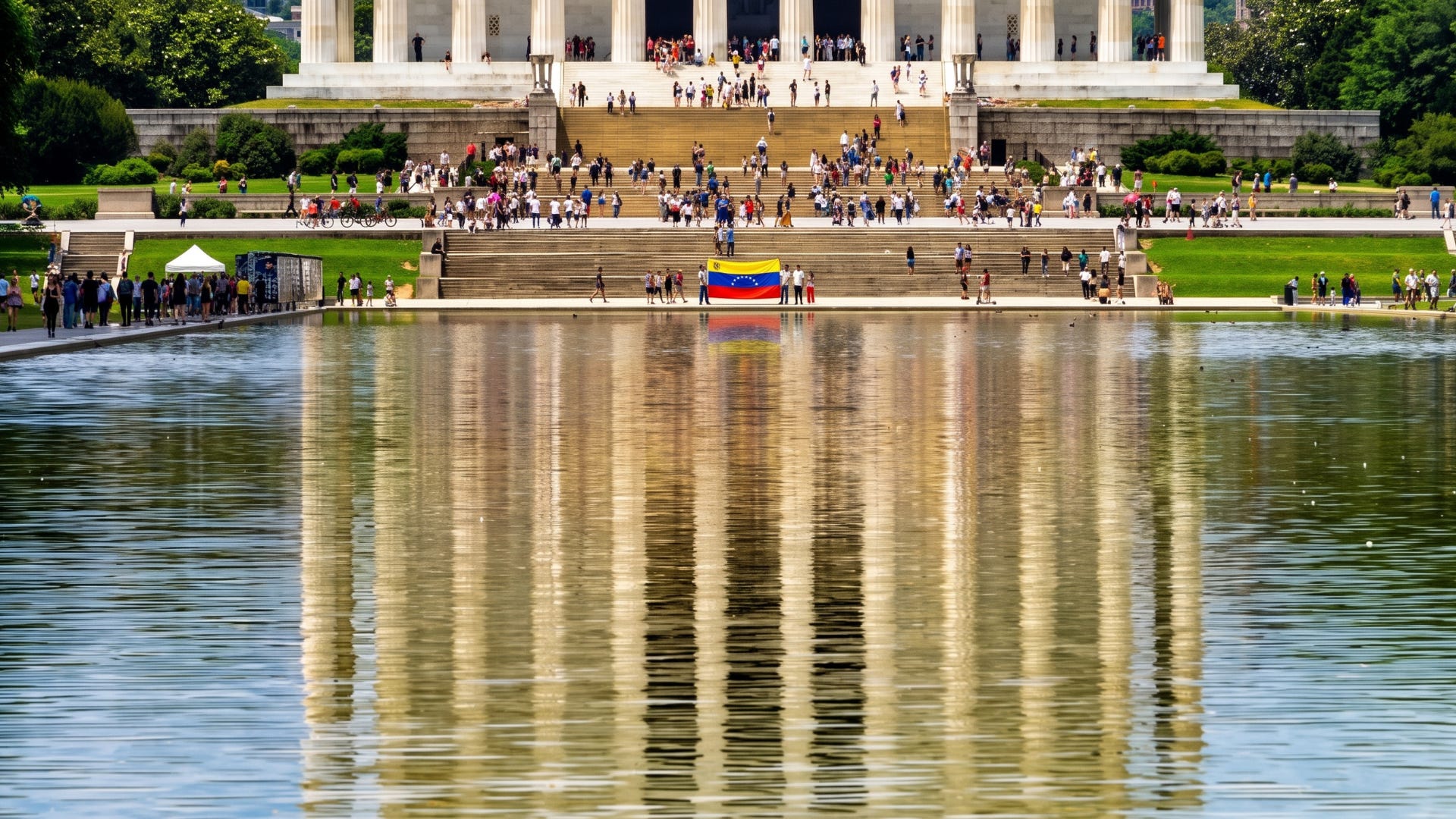
Stand at the edge of the Reflecting Pool on the National Mall and you look down to take the measure of what rises above you. Henry Bacon wanted the water to double the monument. Washington’s politics invert the gesture. Whoever leans over that edge is not looking for the monuments. He is looking for his own face.
Two lucid readings of last week’s congressional upheaval illustrate the first blindness. David Smilde —a sociologist at Tulane and at the Washington Office on Latin America— took inventory, with the restraint of a man who refuses easy prophecy, of what survives of U.S. policy toward Venezuela. Andrea Mesa-Atencio drew the legal filigree: subpoenas returning to Democratic hands, spending bills newly subject to negotiation, the more than thirteen billion dollars in oil revenue a subcommittee will demand to audit in January. Both diagnoses are impeccable. And both, without meaning to, confirm an old servitude: they are written for metropolitan consumption. They are foreign-policy memoranda addressed to a power that notices us only when it trips over itself.
That Smilde writes from Washington is only right; it is his country and his trade. What troubles me is that the Venezuelan transition, in these schemes, shrinks to someone else’s domestic arithmetic: whether Democrats prefer televised hearings to gunboats, whether Marco Rubio needs a diplomatic trophy before the next campaign, whether Europe will stir once the United States decides to yawn. When an American scholar analyzes Washington, he is doing his job. When we do it, we are borrowing a chair.
A pool returns the face of whoever bends over it. It is not in its nature to reveal the currents beneath.
That is the first deception of the mirror. Washington looks at Caracas and sees its own quarrel: an oversight file, a point of advantage in Florida, a budget fight. It is simply the gravity of empire; there is no malice in it. A pool returns the face of whoever bends over it. It is not in its nature to reveal the currents beneath.
But there is a second mirror, and we almost never look into it. Because not every Venezuelan leans over someone else’s water. Antonio de la Cruz asked, in July, in El Nacional, the only question that matters: are Venezuelans designing their transition, or merely executing a timetable drawn up in Washington? Roberto Casanova, in La Gran Aldea, called for a National Accord to fix the principles of reconstruction before any negotiation. Miguel Ángel Agostini, from the sovereigntist tradition and his platform in Aporrea, warned against “confusing U.S. congressional oversight with Venezuelan electoral sovereignty.” An editorial called for a Republican Pact beginning with the electoral council, the judiciary, and the armed forces. From the hard opposition to dissident chavismo, voices that do not speak to one another agree without knowing it: the task is ours.
This should be the best news of the year. And yet the second mirror returns an image more uncomfortable than the first. Everyone names the task, and no one performs it. “It falls to Venezuelans,” they write, and move on, the way Smilde lets his European line drop and keeps going. “It falls to Venezuelans” is a phrase that costs its author nothing and moves its reader not at all. It is the imperative with which the Venezuelan opposition has been talking to itself for twenty years without rising from the chair. Here the reflection stops returning Washington’s face and forces us to watch ourselves repeating the same slogan into the same glass.
The right to name what happened is not surrendered, and the duty to judge what was criminal is not bargained away. An amnesty either reconciles or conceals; it cannot do both.
Naming the task is not the same as doing it (and I distrust how easily I write that). I will not cure the dispersion with one more essay that says “we must.” An imperative has no date, no chairs, no signature. Rómulo Betancourt—not the one whose oil contract Washington will be investigating tomorrow, but the president from last century—did not write an essay about the need for a pact. He arrived at the State Department with the pact already drafted. Washington could accept it or reject it, but it could not write it. The difference between an ally and a ward is who brings the document to the table.
So the task is not to convene a table—Washington has already done that, in its own favor. What falls to us is to write, among ourselves and before we are seated, what will be defended at this table and the ones that follow. And the first line is a right and a duty: the right to name what happened is not surrendered, and the duty to judge what was criminal is not bargained away. An amnesty either reconciles or conceals; it cannot do both.
We need maps of the other side’s terrain. But a map of Washington is not a strategy for Caracas.
The water will go on returning a face. What remains is to decide whose —and what it carries, written, in its hand.
Pareciera que de este lado, los de la mesa , tienen miedo a resolver lo que se está viviendo en el país, por temor, digo yo, a no molestar a quienes los sentaron.