


To Sara, mi palomita, on her birthday
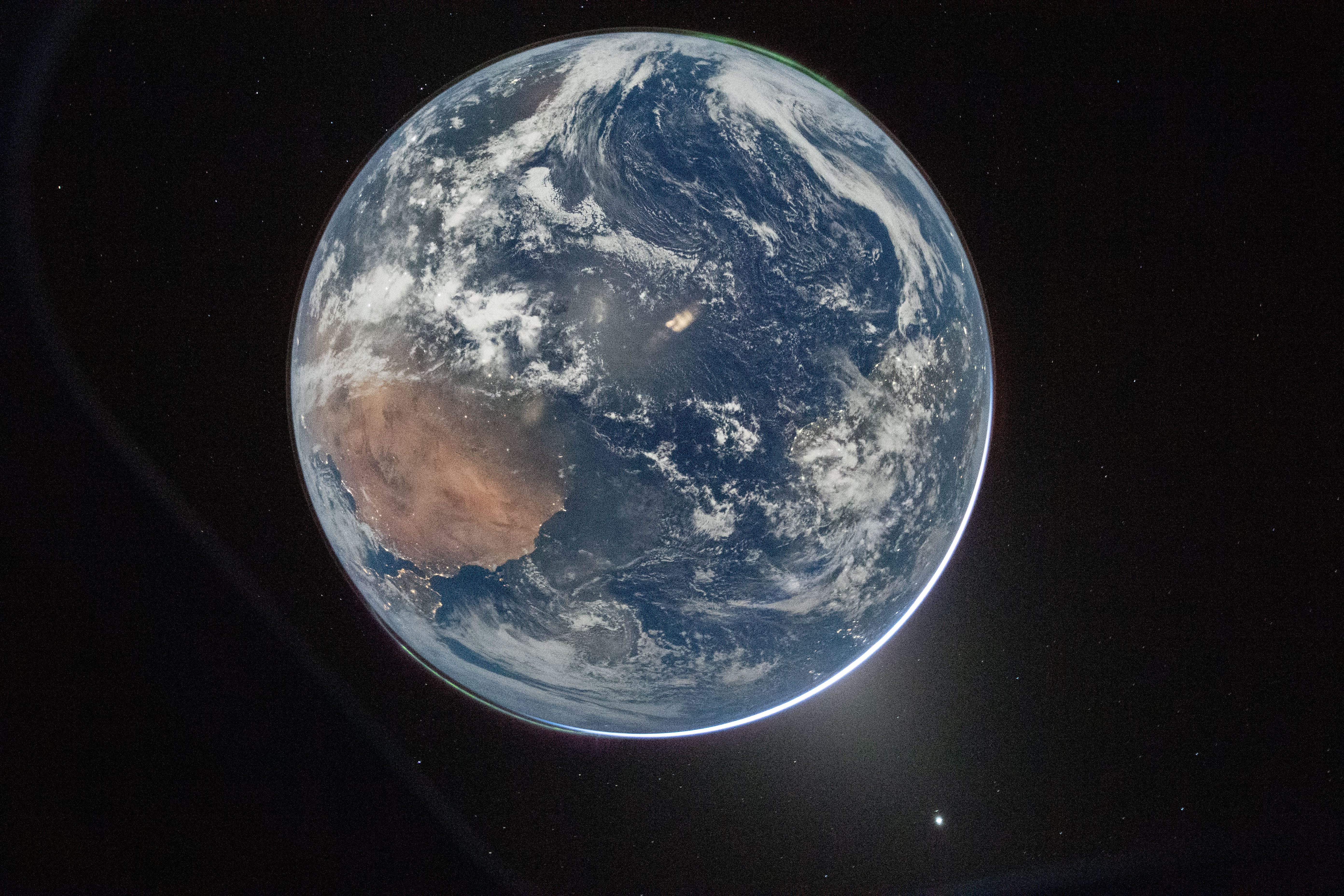
Reid Wiseman pointed a tablet camera through Orion’s window and pressed the shutter. What came back was the astonishing vision of the whole Earth, Africa and the Iberian Peninsula tipped toward you. It reminds me of my daughter’s face turning in sleep, her hair braided as cloud systems across the pillow of the Atlantic. At the planet’s northern edge, a green aurora, bright as a secret, pulsed in the upper atmosphere. No border visible. No wall or customs line. Just water, air, and that paper-thin membrane holding us, all of us, in the same fragile mercy that involves a child in her dreams.
I know, perhaps I’m adding too much to a photograph taken from space. But this image has stayed with me after it arrived on April 3, two days after Artemis II launched from Kennedy. By the time most of us saw it, the crew was already a hundred thousand miles out and accelerating toward the Moon. NASA says that today, they fly around its far side, the first humans to do so since 1972. For forty minutes, as Orion passes behind the Moon, even their radio signal will disappear, and four people, briefly be more alone than anyone alive.
Seeing Earth from that distance does something to the mind. It has a name: the Overview Effect. It’s the moment when no election district, no passport, no frontier survives the altitude. The cartographer’s confidence dissolves, and a question remains that the photograph cannot stop asking us: if home looks whole from here, why do we keep breaking it down there?
We build walls first for safety. Then it becomes an identity, and it promises us that what is outside cannot become our burden. The wall makes us believe we are innocent at last.
But every wall contains its own paradox: the structure we raise to protect ourselves becomes the cage that keeps us from seeing clearly. Borders are sometimes necessary as instruments of law and order, I won’t argue the contrary. But they become dangerous when hardened into metaphysics, when a line on a map is mistaken for a line in the soul.
While Orion carried the language of long horizons, at the White House in Washington, Stephen Miller has been narrowing the circle at home. Miller set ICE a daily quota of 3,000 arrests. To meet it, agents stopped targeting anyone in particular and adopted mass roundups (at churches, schools, courthouses). It will be engraved in our memory that in Minneapolis, federal agents killed two residents within two weeks: first Renee Good, then Alex Pretti, an ICU nurse whom Miller initially called an assassin before the video showed otherwise.
Two million people have fled the country rather than risk being hunted. The administration calls this self-deportation. A plainer word is terror. If our space travelers, while orbiting the Moon, focus their gaze and pay attention to the signs, they will see the unmistakable path left by eight million people self-deporting from Venezuela, seeking safety on Earth.
We keep saying we are securing the house while terrorizing the people already inside it.
That is where the Overview Effect stops being a wonder and becomes judgment. If we cannot enlarge our idea of belonging on Earth, our talk of becoming a multi-planetary species is imperial nostalgia in a new spacesuit. If we sort the stranger by passport, income, accent, or removability here, we will do the same there, only with better optics and more sanctimonious language about the future. The Moon must not become the last gated community.
Love is not sentiment. It is method: the courage to cross toward what is unfamiliar without first demanding that it resemble us.
The real test is not whether we can get back to the Moon. The crew of Artemis II has already answered that. The test is whether, having seen the Earth again as one lit thing in the dark, we will have the nerve to act as if we believed it.