


(Leer en español)
Unfurl an official map of Venezuela on a polished table in Washington, and the country looks like a promise of order: crisp borders, administrative colors, abundant oil fields and mines, and highways stitching the territory into a rational geometry. It is a comforting image, domesticated, tailored for hands that sign memorandums.
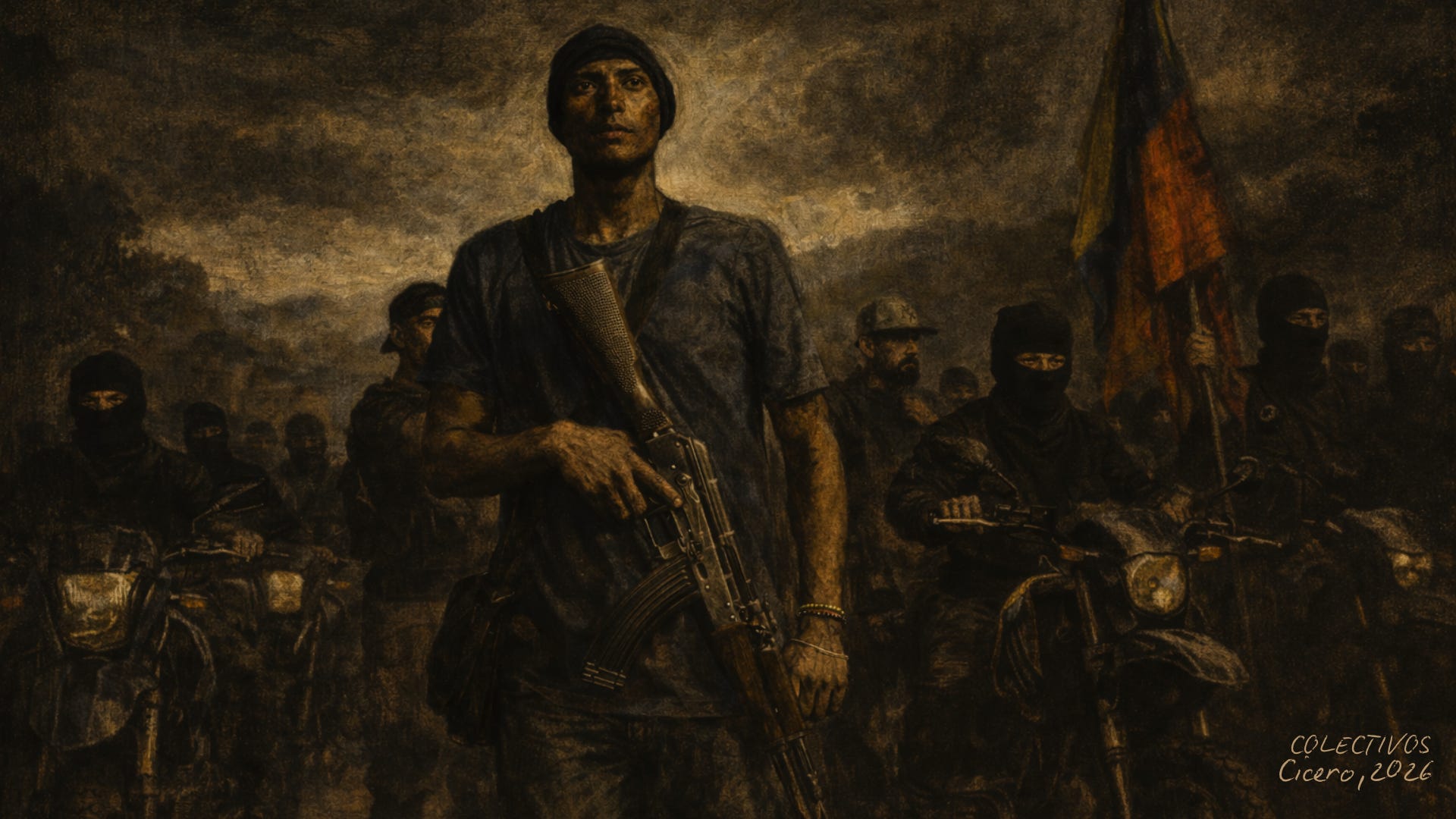
But the map is a fiction. It fails to demarcate the paramilitaries controlling the interior or the colectivos patrolling the cities. It hides the checkpoints where police and armed gangs continue to detain, extort, and terrorize the civilian population.
The official map is not the territory. That mas it is an artifice. A lie.
From ground level, Venezuela increasingly resembles an archipelago of armed fiefdoms. The state exists on paper and on television. On the ground—where dust mixes with toxic mercury in the mining zones and the air carries the sour residue of sweat and diesel—authority is delivered at gunpoint, negotiated checkpoint by checkpoint, and enforced by whoever controls the local economy of fear. In the Orinoco Mining Arc, a presidential decree often matters less than the gram of gold a teenager claws from the mud under the gaze of an ELN guerrilla.
Laws are not the ones written, but the ones the Kalashnikov allows. That single reality is what makes the current moment so dangerous—and so absurd. Washington is acting with caution by keeping the old regime practically intact. Also, it seems delusional, tempted by a mirage while attempting something close to a historical anomaly: managing a chaotic country from a distance.
The Remote Viceroy Problem
After proclaiming that the Maduro regime had been “decapitated” in a dramatic raid that removed him to a U.S. jail, Donald Trump began speaking as if sovereignty were a switch he could flip from Florida. “We’re in charge,” he declared, describing a supposed capitulation by Venezuela’s new interim leader, Delcy Rodríguez, as a desperate plea: “She said, ‘We’ll do whatever you need’”.
This assertion might appeal to the self-perception of a supreme leader aiming to influence American domestic politics. Yet, governing Venezuela proved difficult for the Spanish empire and for the leaders of the new republic alike. “Venezuela is like dried hide” is a well-known nineteenth-century saying attributed to former president Antonio Guzmán Blanco, evoking the country’s toughness: “step on it in one place, and it springs up somewhere else.”
Let’s say it has been extremely challenging for its military dictators, its democratic presidents, and also for the corrupt and inept revolutionaries who so cruelly squeezed the nation for the last quarter of a century. They possessed money, technology, weaponry, and American and Cuban-trained police and troops, and some among them even enjoyed significant popularity, legitimacy, and peace. I hope you’ll understand if I’m skeptical, even fearful, that this experiment might not succeed in Venezuela.
The United States has had no functioning embassy in Caracas since 2019, no military personnel on the ground, and no routine way to enforce compliance across a fragmented territory. Trump’s claim to be running the country rests exclusively on the assumption that the government will obey out of fear. While the threat of a “bigger” military assault or the seizure of oil tankers instills fear, it does not equal governance. Call it neocolonial tutelage via press conference: a viceroyalty attempted at a distance, through messaging and punishment, is destined to fall short.
The Hydra, Not the Pyramid
Here is the paradox that analysts too often miss. Removing the apex does not dissolve the structure when the structure has already metastasized.
Maduro sitting in a U.S. jail is deeply satisfying theater. It may satisfy the logic of a raid, but it does not restore the logic of the state. Venezuela is not a monolithic army that will sign surrender papers once its leader is gone. It functions more like a molecular hydra: military factions, intelligence cliques, criminal syndicates, guerrillas, and paramilitary patronage networks.
In that ecosystem, the “civilian” leaders currently in Miraflores, Delcy and Jorge Rodríguez, do not command the guns so much as bargain with them. They must negotiate the government’s future with the actual power brokers: the Defense Minister and the Interior Minister, yes, especially Diosdado Cabello. These men control the armed forces, the police, the intelligence services, and the irregular forces—including colectivos and ELN guerrillas—whose loyalties are transactional and whose businesses depend on disorder.
A remote strategy that treats Venezuela like a conventional state risks confusing formal power with real power. Controlling the palace is not the same as controlling the ports, the pipelines, or the neighborhoods where sovereignty ends at a barricade.
Oil as a Contract with Smoke
Washington’s objective, described in the blunt language of transaction, is simple: deliver the oil. Secretary Rubio has framed the goal in terms of national interest, stating clearly that “the number one objective is America”.
But oil is not extracted from slogans. The rich territory’s treasure demands infrastructure and security. Venezuela’s defining problem is precisely that no one actor fully controls those things.
Even if an interim government signs agreements to open the oil industry to U.S. interests, who guarantees them at the refinery gate? Who protects a pipeline from sabotage in a corridor controlled by armed networks? Who assures investors that a contract signed today will still matter tomorrow in a country where violence has market value?
In a landscape where coercion is fragmented, crude becomes less a commodity than a hostage. The premise that the United States can extract the country’s natural wealth without the hard work of institutional reconstruction is not realism but wishful thinking.
The 100-Year War Logic
Diplomats still invoke the Weberian idea of the state’s “monopoly on violence.” In Venezuela, the phrase lands like dark comedy. Chavismo’s defense doctrine has long leaned on asymmetry: if you cannot win as a conventional power, you arm the populace and launch a guerrilla war.
Interior Minister Cabello has invoked the Vietnam model, promising a “revolutionary war” that would last not days but “100 years”. Whether he can deliver a century matters less than the conditions that make chronic insurgency plausible: a country awash with guns and armed groups.
In such a country, it does not take a massive army to paralyze the state. A few committed militants can mount an effective destabilization campaign against an incoming government. If Washington pushes for extraction without reconstruction—mistaking temporary silence for submission—the likely result is violent rupture.
The Somalia Outcome
The most immediate danger is not merely the reconstitution of chavismo under another label. It is the consolidation of something worse: a Caribbean Somalia—where national symbols are preserved as décor, while real authority belongs to whoever holds the machinegun at the checkpoint.
Washington’s decision to leave the remainder of the government in place may have avoided immediate collapse, but dictating outcomes “over the heads of the Venezuelan people” invites institutional corrosion.
Democracy requires citizens. These micro-powers require only subjects. Converting the latter into the former will require years of institution-building and a clear commitment to a domestic political settlement. Washington’s current posture suggests the opposite: transaction over reconstruction, extraction over governance.
History is stubborn on this point. You cannot sign a durable contract with a ghost. And you cannot pump oil from a burning well.
