


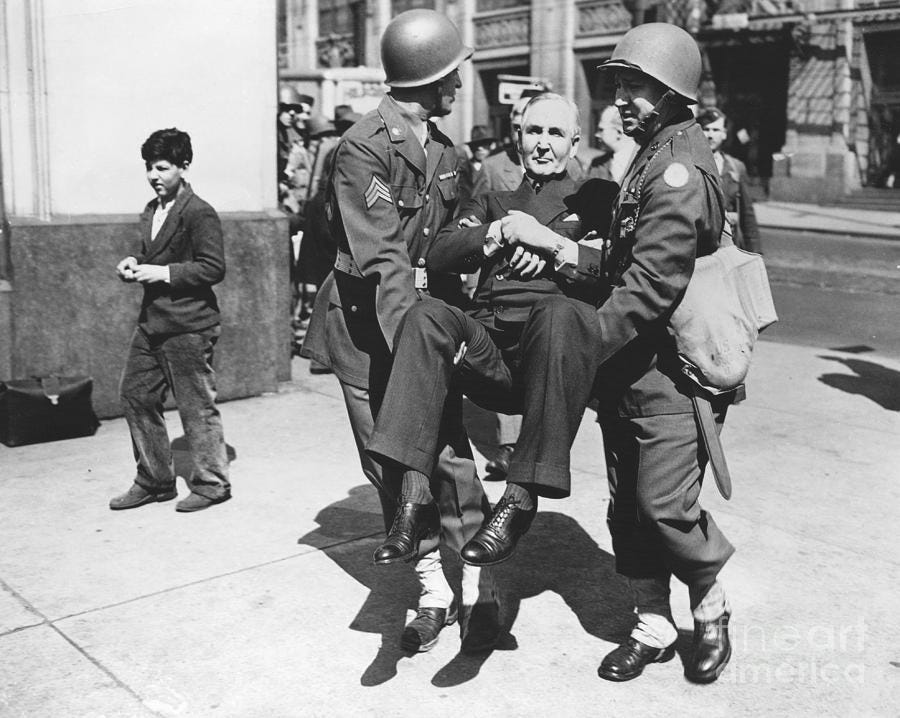
Chicago, April 1944. Two helmeted soldiers carry Sewell Avery, chairman of Montgomery Ward, out of the company’s building. They hold him aloft, each with an arm under his knees. He is a piece of furniture that carries the shape of his chair pressed into his body. He looks as starched as his suit, the crease in his trousers intact, his left hand gripping his right wrist. His bearing is at once unyielding and relaxed. Behind them, a boy plays with something between his fingers. He is in his own world and walks as if nothing extraordinary were happening. Lower left, propped against the wall, an executive briefcase lies abandoned. It did not fall (perhaps someone set it down to free his hands; a small mystery the photograph keeps to itself).
Paul Krugman reproduced the image this week and barely paused over it. It illustrated his argument that Starlink cannot remain under Elon Musk’s control. In his reading of the photo, the state defeats a private man who believed himself bigger than the war. But I look at it from another angle and, instead of a victory, I see a border: a state that still knew where private business ended and where the public building began. A state with two uniformed men of rank to draw the line and make its sovereignty good. The briefcase, with its documents, memoranda, and property deeds, stayed out on the street. Avery lost, but he lost to something with a name, substance, and physical presence.
Defenders of the new order will say that the twenty-first-century state cannot build its own rockets and needs the speed of tycoons. True, but they confuse the contract with sovereignty.
That border is what is missing from the story of Ukraine without internet. Its drones went blind one October night. The Secretary of State says there was no order and the White House knew nothing; Musk says it was Trump. Nobody carried anyone. Defenders of the new order will say that the twenty-first-century state cannot build its own rockets and needs the speed of tycoons. True, but they confuse the contract with sovereignty. The problem is not that the state is weak. This new privatized state no longer lives in a separate building. The man who switches off the satellites is the same man who entered the government with a special employee’s badge to prune it from within. The man negotiating with Putin is a real-estate developer. The man deciding my country’s future is not a diplomat either. And the man who summons them is building his ballroom at the White House with, among other pledges, two and a half million dollars from the daughter of a Venezuelan banker he pardoned in January. Krugman asks whether a private citizen may make foreign policy. I wonder whether any state remains that isn’t private.
I come from a place where we learned an answer to this question. Chávez did not storm PDVSA with soldiers: first he fired its board and its engineers with a whistle on live television; then he declared it roja, rojita and ran it as his own hacienda. A state under concession does not need to steal. It is enough that the line between the treasury and the pocket becomes a matter of opinion. After that, everything is bookkeeping.
The example that best explains it in Washington is not Starlink but an airplane. Qatar gave the Pentagon a $400 million Boeing 747. The Pentagon painted it red, white and blue, in the livery of Trump’s private jet, and the White House already takes it for granted that when he leaves office the aircraft will go to his presidential library. A gift to the nation that ends up in the king’s coach house. (Louis XIV never said L’État, c’est moi; the line was invented later, but it lasted because it described what he actually did: reduce France to his household court.) While the presidential family reports more than $1.4 billion in cryptocurrency since its return to power, the president insists that everybody is reaping benefits. On conflicts of interest, he told the Times in January: “I found out that nobody cared.”
A state under concession does not need to steal. It is enough that the line between the treasury and the pocket becomes a matter of opinion. After that, everything is bookkeeping.
That is the sentence. Not the plane, not the coins. “I found out that nobody cared.” I heard it in Caracas with a different accent. A quién le importa. It has the structure of an experiment: someone crossed the line to see whether anyone was still on the other side. There was no one.
Cicero wrote that the res publica is the res populi, the people’s thing, and that under the whim of a faction there is no badly governed republic: there is no republic, however it is numbered—third, fourth, fifth. He did not write it as a theoretical warning. He did it before Caesar, when the Republic still had all its institutions, and he had already foreseen how a city is emptied without touching a single wall.
Back to the photograph. Avery holds his own hands and goes calmly because he knows they will set him down on the sidewalk and that in a few weeks he will be back at his desk, as in fact he was. The boy doesn’t look because he doesn’t need to: someone is looking out for him. Today nobody carries anyone out. The briefcase goes in with its owner, and the boy keeps walking the sidewalk without raising his eyes. Nobody looks out for him now.