


(I originally published this article on June 18, 2018, on my personal blog and on Medium. I have retrieved it from the archive to create my own benchmark and better understand how my writing process and my relationship with language and the craft of writing have changed over the years to arrive at Cicero.)

My primary school teacher reviewed our notebooks with an expression that was already a verdict. When she reached mine, her chalk-scented face closed. “You didn’t turn in the homework again, Santodomingo.” “I did do it, teacher, look.” “Don’t lie, Santodomingo. You didn’t write this — your mother wrote this part and a cockroach wrote the other.”
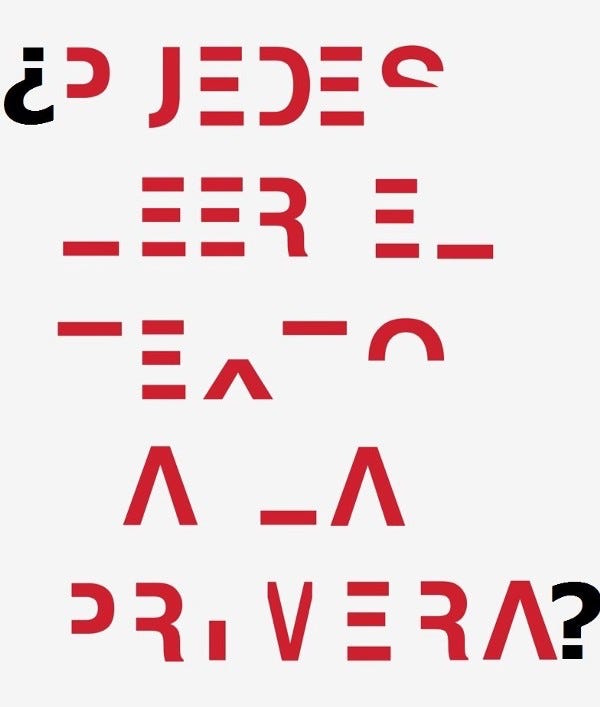
A cockroach. For years I carried that phrase the way one carries an unnamed diagnosis. My writing had two rhythms: one slow and careful, both in the choice of words and in the handwriting, and another unbridled, inspired, with errors that were sort of mispelled hieroglyphs.
My spelling was grounds for mockery, my handwriting a scandal, and I was also clumsy and, most of the time, distracted — “en las nubes, ” enough to be classified as an absolute disaster. If I did something well, I hadn’t done it; someone must have done it for me. So from the age of six, I learned to hide the fact that reading cost me effort. I memorized even the spelling and rehearsed what I had to say. I didn’t do it well at first, but from masking it so often, I learned to do it for real.
Perhaps I was a little slower than average. Over time, I learned to go from an ordinary reader to a passionate one by mastering oratory techniques. I carried that secret through all of childhood: the secret of knowing myself a linguistic fraud in a house where books were venerated. My father and mother treated literature and study with a seriousness that was never declared — it was simply there, in the floor-to-ceiling library, in the books that appeared in every corner of the small apartment. For me, words were not merely a school instrument. They were the condition of belonging to my own family.
I arrived early, then, at an understanding of what today is called, with less grace, personal branding. My strategy had three moves. First: prepare twice as much, do the homework in advance (though, addicted to adrenaline, I always left some difficult details for the end), read the next day’s pages twice if necessary and repeat them aloud. Second: bring books from my father — those with complicated words — learn them and deploy them with the teacher at the right moment. Third: carry in my schoolbag some volume with a Russian or German author’s name on the cover — not out of pretension, but as a shield.
The problem with shields is that they sometimes force one to become what one pretends to be. Several of those books caught me. I couldn’t stop at the few pages the disguise required. This had one bad consequence and one good one. The bad: I came across as a show-off and didn’t have many friends. The good: I found in those books a company that did not grow impatient with my slowness.
That is how I survived primary school. In secondary school I already sensed that if not by intelligence, then by sheer effort I could go far.
Not long ago, a friend found on YouTube a video of one of the most embarrassing moments of my life. I was sixteen and had been selected unanimously to participate in a television program as the “genius” of the school — a program with a national audience. It was the summit of all my effort to dissemble. It was also the highest risk of being discovered. And so it was.
I may have had information, but my response speed could never compete with the urgency of television. The universe conspired, furthermore, with sports questions. For me, volleyball was a girls’ game, basketball was for people whose limbs had been stretched, and baseball was an invisible ball that, in my experience, could cause a great deal of pain. With soccer I felt somewhat better because I ran fast — besides, a practice or a regular match represented for me an opportunity for a good hour of uninterrupted reading on the bench.
The stardom was followed by days of solitary confinement. I avoided those who did not avoid me, locking myself at home or entrenching myself in the library during recess. Weeks later, I sat the national university entrance exam. The day before I didn’t leave the library, hidden during class hours doing practice tests. Until the physics teacher found me there and threw me out with a reprimand.
That year I was one of the three students with the highest score in the country. The next day the teacher publicly congratulated those who had achieved the best results in mathematics and in language. I was not among them because, although mine was the highest score in the country and in the school, it was a composite result, balanced between language and mathematics. “Some people think they’re geniuses, but what they do is memorize the questions,” said Professor Noel, leaving no room for doubt.
I knew he was wrong. But in front of my classmates I had been unmasked all the same. My television debut and my zeal before the aptitude test had exposed me as a fake — which is, curiously, the same accusation with which everything began.
Shortly after I was admitted to university to study journalism. I thought my dark past would be just that: past. What was opening was not a world for proving who I wasn’t, but one for cultivating, without complexes, my appetite for words.
It was then that, for the first time, a specialist administered a battery of cognitive tests. The psychologist asked me: “Why do you want to be a journalist or a writer? Being dyslexic, don’t you think you could explore other areas where you might succeed and be happier?”
Dyslexic, me? I asked her to elaborate. To explain what that meant and how it was cured.
The diagnosis allowed me to understand myself better. But since there was no special treatment for dyslexics at university or in life (quite the contrary), I preferred to keep it secret. And the psychologist’s argument, whatever it was, did not dissuade me. I had already decided what I wanted to be.
Here is the pivot the story doesn’t state but contains: the child who hides his dyslexia behind Dostoyevsky in a Caracas apartment, who later decides he will write in a language that is not his own, is making the same move twice. Language as territory that belongs to him not by right but by conquest. Identity as something worn with effort, not with ease. Exile — from one’s own language, from one’s own country — begins before one knows one is in exile.
That child (like the adult) must periodically relive the terror of being the dunce of the class, of being unmasked. Especially when he has had to compete for a job or begin a new project in which, inevitably, his facility with words would be essential. Today he senses that his intelligence is neither greater nor lesser than average (he simply functions somewhat differently). But it has been exhausting to keep that secret. It was a source of shame, especially before his family. Very few people knew it throughout his life.
Today he is not as embarrassed by it. The world tends to be more tolerant toward the broad spectrum of human life, and there is more information about the different types and degrees of dyslexia. For some it is even a source of pride to confess the vulnerability (especially when one no longer has anything to prove). But it remains slippery terrain. Not only because of writing it, but because of embracing transparency about one’s own disability — especially when passing unnoticed is still possible.
He still reads slowly. He writes with effort (an effort he partly manages with the help of Word’s spell-checker1). He has not changed his purpose.
I love words — getting tangled in them and untangling myself from them. I will be a writer, even if in my life I have only a few true friends.
Today my indispensable crutch is called Grammarly.
What a remarkable, self-revelatory piece. I am grateful that you chose to write, and to write in English!