


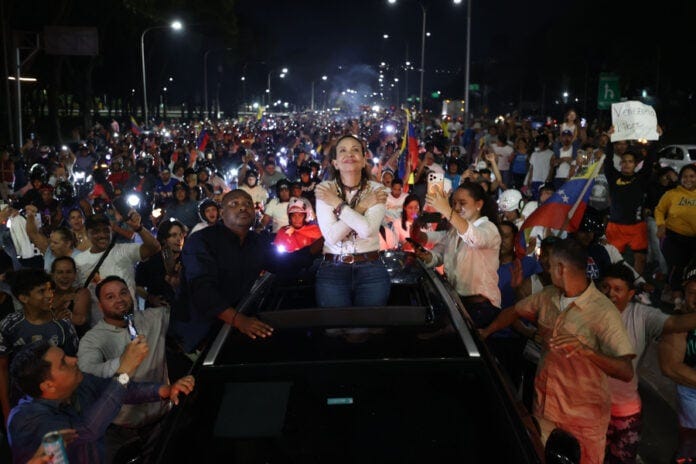
It took María Corina Machado eight hours to drive from Barquisimeto to Caracas. From the shoulder of the highway people kept tossing her the plastic rosaries sold outside the sanctuary of the Divina Pastora, and by Valencia her neck had disappeared under them. That same Sunday in Washington, a reporter asked Donald Trump about her, and his answer fit inside a sigh: “I don’t know anything about it, but I think she’s a very nice woman. She gave me her Nobel Prize. So how can I say anything else? And I hope she’s safe. She’s a very nice woman. But we’re doing really well in Venezuela.”
I kept turning that last conjunction over. What fits behind that but? Outside Rodeo I, relatives of political prisoners climbed the hill shouting at the walls that María Corina was home. From inside came the same two words as always. No one came out.
I distrust caravans (in Caracas, I have seen Francisco de Miranda Avenue full as far as I could see, and I have seen it empty the next morning, wet flyers plastered to the asphalt, as if the city had dreamed it), though this time the unease lies elsewhere: in what could not be seen from the highway, because for ten months it had been running without her.
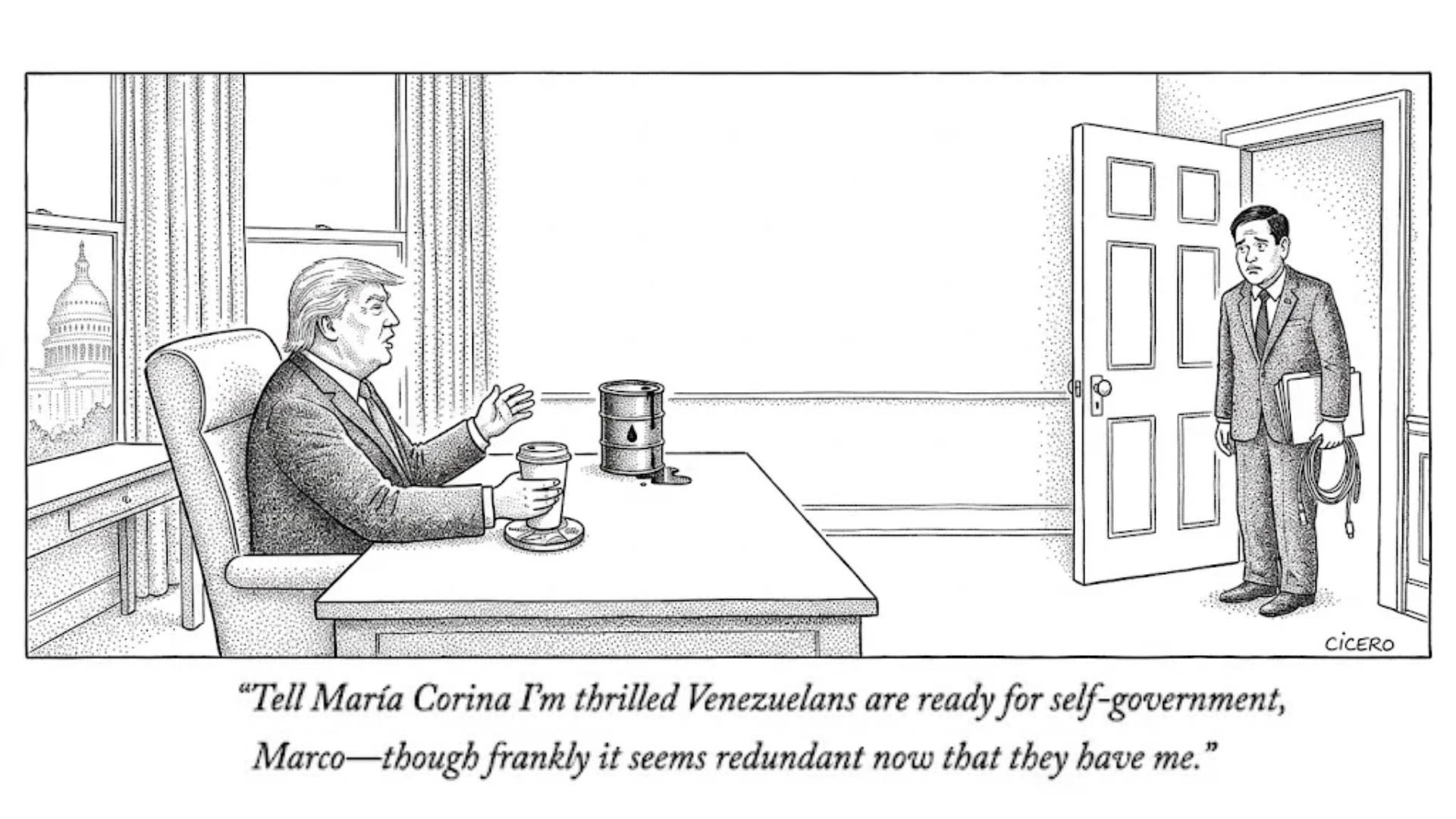
Since a U.S. military operation extracted Nicolás Maduro from Caracas in January, Delcy Rodríguez has administered the country, and her interim presidency, as Guillermo Tell Aveledo warned in TalCual, stands on a floor laid in Washington. In August Trump signed with her what he called the biggest oil deal in history; asked to explain it, he used the word spoils. A week before Machado’s return, with the midterms at hand, he and Marco Rubio posed in Texas in front of a tanker of Venezuelan crude (Efecto Cocuyo); days later Rubio was claiming State Department credit for prying the door open for her (El Pitazo). Nobody in Washington seems to have noticed that the two photographs tell incompatible stories. Or worse: they noticed, and in campaign season you can cash in on both.
What has been assembled over these ten months ought to be called a sublet republic. It operates like a managed bankruptcy: the country is a distressed asset. Washington acts as receiver, and the previous management, decapitated, stays on the payroll because it knows where the shutoff valves are. The secured creditors (the oil majors, the bondholders, the State Department itself) get paid first at the window. Everyone else will collect last, scraping the bottom of the pot, and until then receives an advance in kind that the communiqués call a reconciliation dialogue. The receiver, meanwhile, sublets the premises. In this bookkeeping, popular sovereignty is a volatile gas that must be vented slowly so the pipelines don’t burst. When someone says transition today, ask whether they mean restoring a republic or meeting a payment schedule.
What has been assembled over these ten months ought to be called a sublet republic. It operates like a managed bankruptcy: the country is a distressed asset.
Rome called a province pacified once a rebellious king had been replaced by a punctual tax collector. For twenty-five years Venezuelans fought a messianic dictatorship, and even from exile one grew used to knowing what to shout against. What stands before us now has neither face nor fervor. The former jailers review institutional drafts with the 2015 National Assembly and with career officials in technical English; political prisoners occupy a cell on another spreadsheet, and anyone who asks after them is prescribed patience. We will be told that this is how tragedies end in the real world: that the tedium of accountants beats the lead of the barracks, and that an exhausted country needs the wells pumping before it can count ballots. It is a seductive argument for anyone who has spent twenty years in the dark, except for one detail: it confuses the pacification of an oilfield with the founding of a country. Against a receivership, no slogan holds.
That is why Machado’s return is more dangerous than the highway photographs suggest. Someone else already toppled the tyrant, in the most literal sense, with helicopters. She walked back into a room where everyone else had signed, and in a room like that moral authority gets in the way. She thanked Trump, as protocol demands; she asked for a 2027 election date (El Pitazo) and questioned the fine print of the oil deal, which is the only thing an unsecured creditor can do to be heard: speak out of turn.
A democracy born of a lease arrives with its clauses drafted elsewhere. The day those elections are held, if they are held, we will have to ask who dictated the deed under which the ballots were cast, and those of us who were not on the road from Barquisimeto on Sunday can already guess the answer, which is another way of saying we were not on the creditors’ committee either. She left her medal on a table in Washington so her country could have a ballot box; there they put the gold behind glass, bought the crude, and left the keys with the warden.
At the Rodeo, the prisoners heard her name. But they are still inside.