


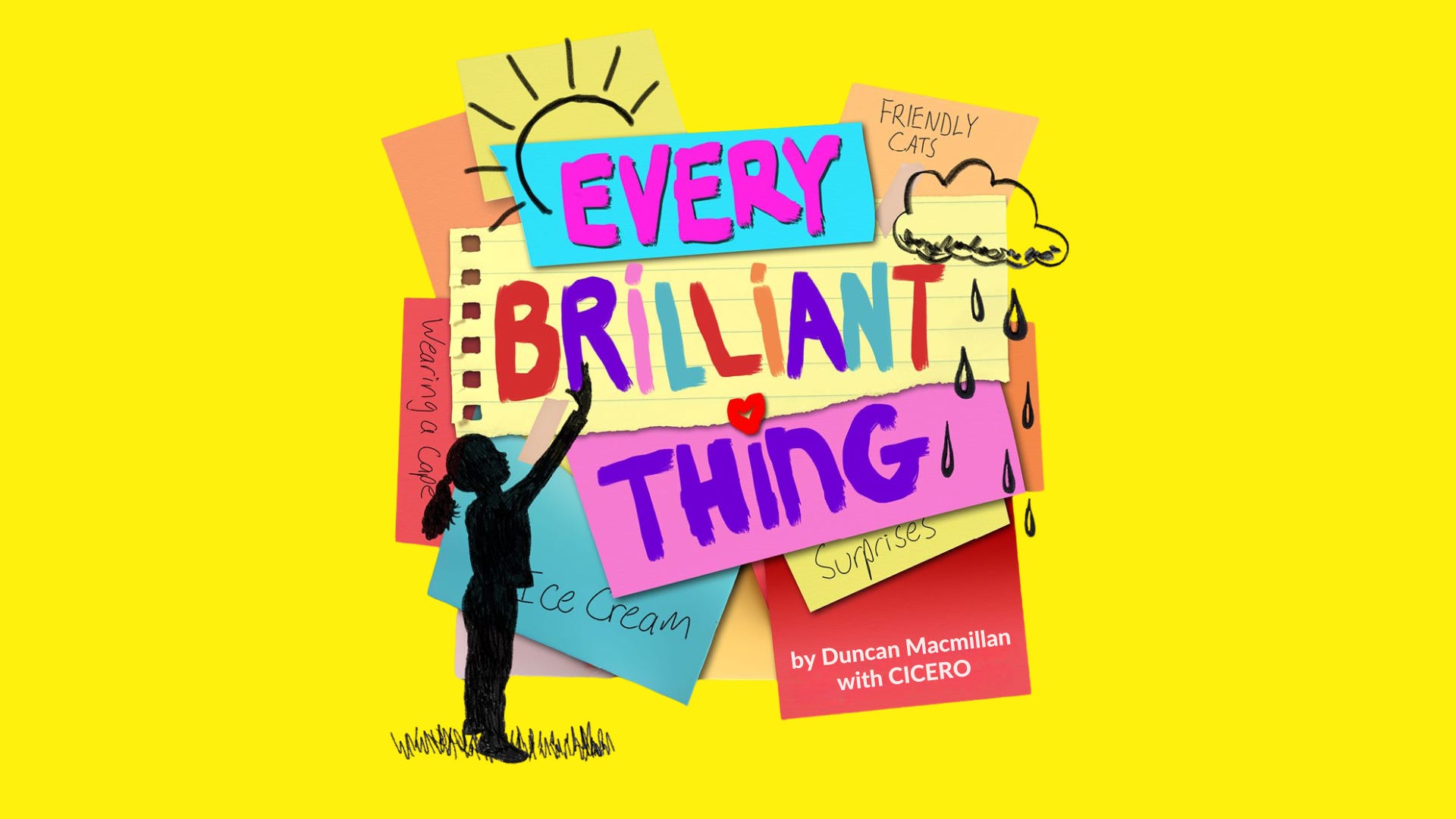
It’s Saturday morning and my studio smells of coffee. On the desk, there is a page from the script of Every Brilliant Thing with a circle drawn in pencil. The circle marks two sentences:
“That horrible feeling when something is broken and can’t ever be fixed. The trapdoor swinging open. Fight or flight or stay as still as you can.
I’d been feeling like that for a long time.”
The second sentence is the one that stops me. The first describes a moment: Sam, the narrator’s wife, leaves him, and the narrator’s body responds the way it responded when he was seven and his father picked him up late from school. The trapdoor of danger. Fight or flight or hold still. The familiar one. The second sentence is something else: it is the discovery, in full adulthood, that the trapdoor never closed. That it had been open for twenty years. That adult life had been the wallpaper over the crack.
I have been trying for several days to read the passage aloud without stopping. I haven’t managed it yet.
In a few weeks I am going to perform Duncan Macmillan and Jonny Donahoe’s play, which has been touring the world with real actors in the role (on Broadway it is Daniel Radcliffe). My friends, my family, and my community in Bethesda will have to put up with me. At least the play is short, about an hour. There is no set, and the houselights stay up. The narrator enters as the audience takes their seats and hands out numbered slips of paper with brilliant things written on them by hand: 1. Ice cream. 2. Water fights... 4. The color yellow. When the narrator calls a number, the person holding that slip shouts out what’s written on it. Audience members are pulled in to play the vet who puts down the childhood dog, the father driving to the hospital where the mother is, Sam, the school counselor, the literature professor. The play cannot be done without them. That is the thesis as well as the method.
The play is terribly funny and moves you, and it’s a comedy after all, but Macmillan planted the trapdoor sentence three times. The first and second times are the body of a child, and later of an adolescent, responding to the news that his mother has tried to kill herself. The third is the body of an adult responding to the woman who loved him, leaving. The body has not learned anything in twenty years. The trapdoor is the same trapdoor. That is the diagnosis the sentence delivers. Not that something broke, but that the breakage was always there, and one had been living on top of it.
The actors who have played the narrator have spoken about the line that stops them in rehearsal. The answer is never what you would expect. It is not the mother in the hospital. It is not the dog. It is not the funeral. It is always an oblique line, one that slips in through subordinate clauses and diagnoses the actor before describing the character. “Happiness scared me because it was usually followed by,” said Donahoe, the original performer, and left the sentence unfinished. Others stop at “if you got all the way through life without ever once having felt crushingly depressed, then you probably haven’t been paying attention.” Each actor finds his own trapdoor in the script. That is why the play can be performed thousands of times and never be the same.
Mine is the literal trapdoor. I’d been feeling like that for a long time. Llevaba tiempo.
Venezuela will not return (not the one that was my homeland). My work, like that of the entire international development sector, is in a season of uncertainty. The work of love was postponed when it still could have been done. None of these things appears to be repairable.
The narrator’s father, in the car, explains to the boy that he cannot answer all of his whys. He tells him that knowing everything is impossible, and that it would not be enough anyway. That imagination is what makes life bearable. That in order to live in the present, you have to be able to imagine a future that will be better than the past. That’s what hope is, says the father, and without hope we couldn’t go on.
You cannot fix the country that was lost. You cannot undo the hunger of past days, working backward: people move on, change or die. You cannot recover the years of love that were postponed: you either loved or didn’t, you received love or not.
What you can do is build a new nation from exile, find a new mission, love now, without fear of what has already been left behind. Not as therapy. As officium: the discipline of continuing to name what matters, out loud, in front of other people.
That is why I want to do this play.
Soon I will be in a room in Bethesda with the houselights on. I will hand out the slips of paper. I will ask one neighbor to be the vet, another to be the father, and another to be Sam. I will say the trapdoor sentence out loud, in English, in a suburb of Maryland that is not my country, in front of people most of whom do not know where I come from. However, I will trust, because the entire play is a wager on that when I call number one, someone in the room will shout ice cream, and when I call two hundred, someone will shout hammocks, and when I call five hundred seventeen, someone will shout knowing someone well enough to get them to check your teeth for broccoli.
The list did not save the narrator’s mother. The play is very clear about that. The list was never going to save her. What the list does is something else: it teaches the one who writes it to pay attention. And when it is read aloud, in a room with the houselights up, it teaches the room the same thing.
In a broken world, not everything can be fixed. But no one has to be alone with what cannot be repaired. Not even to name it.
That is the work. That is the play.
I make my own list. You make yours. Better still, we make it together.